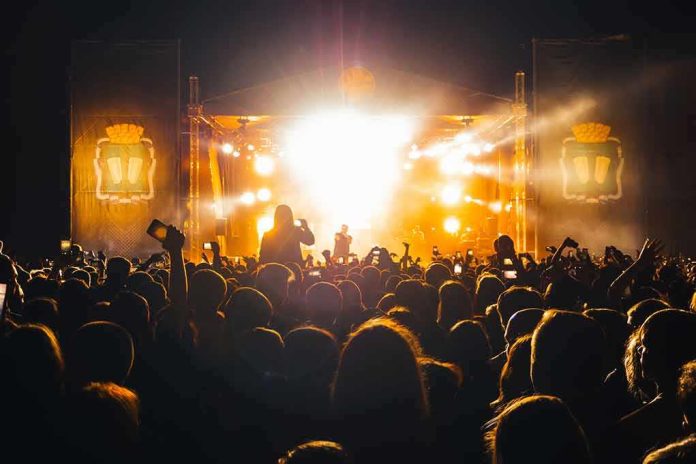
In modern stadium touring, artistic speech is only half the story; the other half is venue and promoter control, which can decide who gets a microphone at all.
The Short Version
- Ed Sheeran’s tour became a case study in venue and promoter power after Macklemore’s onstage “Free Palestine” remarks triggered venue objections and a lineup change.
- Sheeran said the decision to remove Macklemore was not his, citing promoter control and venue ultimatums; remaining openers and his band then walked out in solidarity.
- Only after the fallout did Sheeran deliver first in-person comments on Gaza, calling the situation “catastrophic, unjustifiable, and disproportionate,” while condemning the Oct. 7 Hamas attack as “horrific”.
- This episode fits a broader pattern: politically charged speech collides with risk-averse stadium operators, and the pressure point is cancellation risk, not just fan sentiment.
What actually happened: a promoter–venue triangle, not a single artist’s whim
After Macklemore’s early-tour remarks supporting Palestinians and criticizing Israeli policy, a rapid chain of industry responses set in. Messina Touring Group, the promoter, said it had been told by multiple venues that shows would not proceed with Macklemore on the bill; the implication was stark—keep him, and risk cancellations affecting hundreds of thousands of ticket holders. Sheeran publicly stated that removing Macklemore “was not mine” to decide and pointed to the promoter’s contracting authority. Within hours, the rest of the opening acts—and, according to contemporaneous reporting, his band—quit in protest, underscoring how unusually combustible the situation had become.
This is the core, documented architecture of the dispute. The pressure did not flow strictly from “fans versus artist,” but from a familiar triangle in stadium touring: promoter, venues, and the headliner trying to prevent a routing collapse. That division of responsibility is consistent with the public statements by Sheeran and the promoter and with the walkouts that followed.
Sheeran’s first in-person Gaza remarks: late, calibrated, and double-anchored
Only after the lineup turmoil did Sheeran deliver substantive, in-person commentary. He called the devastation in Gaza “catastrophic and unjustifiable and disproportionate,” but also described the Oct. 7 Hamas-led attack as “horrific”—a dual framing that condemns terrorism while indicting the scale of Israel’s military response. He apologized for “mistakes,” emphasized that he had tried to build bridges, and said he opposed a world where venues pre-approve performers’ content. The timing matters: he had largely avoided explicit political speech in his career, and he asserts that the humanitarian scale compelled him to speak. Whether one reads that as reputational triage or a moral inflection point, the words themselves are on the record.
The evidence does not prove that any single faction “forced” him to speak; it does show that his first detailed remarks arrived after a week in which the promoter cited venue ultimatums, Macklemore alleged pressure by stadium owners, and Sheeran’s support slate disintegrated. In that context, the calibration of his remarks—condemning both Hamas’s violence and Gaza’s devastation—reads less as a partisan line and more as an attempt to stake out a humane center while keeping a tour afloat.
Where accounts conflict—and what holds up
On the narrow question of who removed Macklemore, accounts diverge. Sheeran attributes the decision to the promoter operating under venue constraints; Macklemore’s camp describes Sheeran and his team as responsible. Without contracts or internal correspondence, intent and agency remain contested. What is not contested is the promoter’s public statement that venues would not host shows with Macklemore, and that this threatened tour cancellation—a claim echoed across multiple outlets and consistent with how stadiums manage reputational and security risk. On evidentiary strength, the promoter-and-venues explanation has the more specific and repeat-corroborated record.
The second conflict involves motive: did Sheeran “cave,” or did he act on principle? Assertions about motive outstrip the documentary record. We have the sequence and quotations; we do not have internal emails, rider clauses, or venue directives that would settle whether his Gaza statement was primarily crisis management or conviction. In the absence of primary records, the measured conclusion is simple: his public posture was bridge-building and non-complicity; the environment around him was combustible and operationally constrained.
How the touring machinery actually works
Large-scale tours are governed by layered contracts. A star’s team may select openers, but support acts typically contract with the promoter, who then books stadiums that answer to ownership groups, municipal authorities, and sponsors. When a venue signals it will not stage a show under certain conditions—content, security, or community-relations concerns—the promoter must either reconfigure the bill or risk losing dates. For a stadium run with fixed windows, the leverage rarely sits with a support act; it sits with those controlling the gates and the calendar. That is exactly the dynamic signaled by Messina Touring Group’s statement about venue refusals and cancellation risk.
Seen through this lens, the solidarity walkouts by other openers matter. They did not re-open the venues; they dramatized the industry’s moral fracture but could not reverse a booking reality that had already shifted. The friction point is structural: when politics meets stadium economics, discretion concentrates with entities least inclined to invite controversy that could jeopardize policing costs, insurance, or sponsor relations.
Ed Sheeran Tears Up on Stage at First Concert Since Macklemore Row; Fans Rally Behind Him
New York, Sept 20: British singer Ed Sheeran became emotional on stage at his first US concert since the controversy over rapper Macklemore's removal from his tour. Fans in Philadelphia said… pic.twitter.com/iH8O83EwlC— Voice of Germany (@NewsVOG) September 20, 2026
The broader pattern: Gaza speech as the modern flashpoint
This case is not an outlier. Since October 2023, artist commentary on Gaza has repeatedly met hard edges at the venue and festival layer, from booking retractions to programming disputes. The Sheeran–Macklemore sequence aligns with that pattern: a political statement on stage, a petition or stakeholder backlash, venue pushback, then a promoter-managed lineup change to preserve the route. The practical dividing line has often been cancellation risk rather than a principled arbitration of speech—and that distinction explains why similarly controversial performers with overwhelming commercial leverage sometimes continue booking without comparable obstacles. Scale changes everything: the bigger the stage, the more veto points there are between the microphone and the crowd.
What this means for artists, audiences, and gatekeepers
Three consequences follow. First, artists who intend to make political speech part of their show must anticipate the venue layer—well before the first date—and secure promoter alignment on content, visuals, and tolerance for backlash. Absent that, decisions get made at the last minute by the people with keys to the building. Second, audiences should understand why responsibility can be murky in public statements: headliners, promoters, and venues share power asymmetrically, and each has different risk horizons. Third, if the cultural goal is a touring ecosystem that can accommodate good-faith political speech, the reforms are procedural—clearer content policies, transparent escalation paths—rather than moral, because the choke points are contractual, not philosophical.
What we still don’t know—and how it could be resolved
The record is strong on sequence, weaker on internal causation. We lack the promoter–venue correspondence that would show who first drew a red line; we lack drafts or PR notes that would illuminate the genesis of Sheeran’s Gaza remarks. Those materials—contracts, emails, and calendar holds—would resolve the accountability debate far better than more statements ever will. Until then, the most defensible reading remains the simplest: Macklemore’s speech collided with stadium risk management, the promoter moved to keep the tour viable, and Sheeran responded publicly in language aimed at moral clarity without courting another operational veto.
Sources:
reuters.com, theguardian.com, bbc.com, cbc.ca, billboard.com