

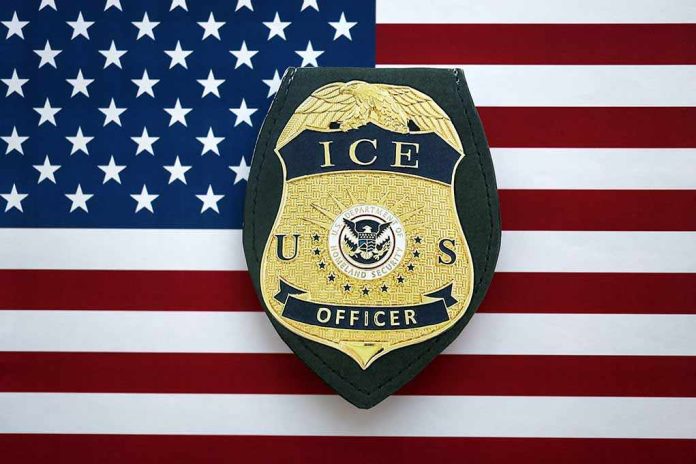
The central tension in the Renee Good case is not just whether a single shooting was legally justified; it is whether a federal enforcement system that concentrates the decisive evidence behind agency walls can credibly police itself when a citizen dies at its hands.
At a Glance
- A Minneapolis ICE operation ended with the fatal shooting of Renee Good; her family’s later congressional testimony framed the death as an avoidable failure and demanded accountability.
- Trump administration officials publicly defended the shooting as self-defense, pointing to officer-shot video they said corroborated a lethal threat.
- Key evidence remains controlled by federal authorities, fueling a larger dispute about oversight of federal officers and the standards that govern use of force.
- The legal pathways to discipline or prosecution of federal agents are narrow, which is why families often press Congress for reforms rather than relying on case-by-case outcomes.
What is established: the shooting, the family’s appeal, and the official defense
Multiple contemporaneous reports confirm that an Immigration and Customs Enforcement operation in south Minneapolis on January 7, 2026, ended when an ICE officer fired three rounds that killed Renee Good. Her mother and brother later testified before Congress, describing a daughter and sister who “should still be alive,” and urging lawmakers to impose real accountability for deaths in federal immigration encounters. They grounded their appeal in a plainly conservative frame—her mother said she voted for President Trump believing federal agents would protect families like hers—precisely to argue the case transcends partisanship. Their testimony made the hearing’s central claim explicit: absent meaningful, external checks, tragedies recur and reforms stall.
The administration answered with a categorical defense. Senior officials said the officer acted in self-defense and cited footage recorded at the scene to argue he had no safe alternative; the Assistant Secretary for Public Affairs stated the video showed Good obstructing enforcement and that the agent feared for his life and those of colleagues. Vice President JD Vance echoed that the shooting was “clearly” justified. The public communications strategy, in other words, rests on the sufficiency of the recorded perspective to settle the central question: was lethal force reasonable at the moment the shots were fired?
The evidence problem: who holds the record and what it implies
For anyone trying to evaluate federal use of force rigorously, the first-order issue is access to the underlying record. ICE policy expects activation of body-worn cameras at the start of enforcement actions, with retention in serious incidents; yet DHS would not confirm whether the shooting officer or others on scene wore body cameras. Public reporting instead describes the shooter holding a cell phone that captured video—useful but not a substitute for synchronized bodycam, dashcam, radio traffic, and after-action documentation that together fix positions, timing, and commands in a way a jury or internal review can test.
That asymmetry—agencies possess the decisive files, the public does not—recurs across federal shootings. Analysts and legal scholars have long observed that immigration enforcement expanded faster than transparent oversight, while the law gives federal officers defenses and forums that can complicate state review or civil remedies. Prosecutors seldom bring charges against federal task-force members; litigation is often shunted into federal court, where qualified and other immunities narrow the path to relief. The upshot is familiar: most of what the public hears early are family accounts and partial videos, while formal determinations, if they come, arrive months later and rarely alter agency posture.
Competing narratives about the critical seconds
The crux of this case is a few seconds of vehicle movement and officer positioning. A widely cited reconstruction reports that Good’s car was angled across the roadway; after verbal commands, she reversed briefly, then moved forward and to the right. At that moment, according to the account, the shooter stood at the vehicle’s front left as it turned away when he fired three shots. That geometry, if borne out by full forensics, would undercut a claim that the driver was using the vehicle as a weapon against the shooter at the instant of fire—an argument central to any self-defense justification.
Officials answer that the officer perceived an imminent threat and responded within his training; they anchor this in the handheld video and statements about obstruction and danger to multiple agents. American use-of-force law does not require an officer to wait to be struck; it asks whether, given what he perceived and reasonably believed at the time, the threat was imminent. That is a fact-intensive inquiry, not a slogan. Full context matters—the sight lines, commands, speed and path of the vehicle, alternative cover or egress, and whether subsequent shots were still justified if the trajectory changed mid-sequence.
The legal terrain: why outcomes so rarely satisfy
Two features shape these cases. First, constitutional doctrine gives officers latitude to use deadly force if they reasonably perceive an imminent threat of death or serious injury; the test is objective reasonableness under the totality of circumstances, not 20/20 hindsight. Second, when federal officers are involved, venue and immunity arguments quickly surface, sometimes invoking supremacy-based defenses against state prosecution for actions taken within the scope of federal duties. Even when a case proceeds, juries must assess each shot, not just the first, against what the officer knew at that moment. These are steep hills for any prosecution, and families often pivot to Congress because policy levers—equipment, training, reporting, independent review—are more tractable than courtroom victories.
That is why the camera question looms so large. If policy requires recording at the outset of enforcement, and if a death occurs without comprehensive, agency-controlled video, the credibility costs are permanent. An officer’s handheld phone video captures what he points at; a body-worn system, in principle, captures the encounter comprehensively and preserves it in ways that accommodate cross-checks. The Associated Press summarized the ICE directive and noted DHS would not answer whether agents at the scene were wearing cameras; that gap is exactly where public confidence drains away.
What accountability would look like in practice
Accountability, properly understood, is not a synonym for conviction; it is the reliable application of rules that deter unjustified force and validate justified force. In a case like this, that means a full, publicly releasable investigative record: synchronized body- and dash-camera footage; radio logs; a precise forensic reconstruction of bullet trajectories, vehicle movement, and officer positions; and any internal training-compliance assessments. If the evidence shows an unavoidable self-defense shooting, the record should carry that conclusion. If it shows avoidable tactics, poor positioning, or shots fired after the threat passed, discipline or prosecution should follow as the rules allow. Families are not asking Congress to guess; they are asking it to make the evidence producible and the standards legible.
There is also a policy layer that does not require waiting on any single case. Congress and DHS can tighten camera activation and retention rules with external audits; standardize after-action releases for deaths and serious force; and route shootings of civilians to independent investigators outside the officer’s chain of command. These are ordinary in many large municipal departments precisely because they stabilize legitimacy after contested force. They are rarer in federal immigration operations, which is why hearings like the one where Good’s family testified keep recurring and why they resonate beyond immigration politics.
Reading the case fairly—today and a year from now
Lead with the facts we have: an ICE operation ended with the death of a citizen; the administration publicly defends the shooting as self-defense; the family’s account and a credible reconstruction suggest the vehicle turned away as shots were fired; the most decisive materials are not public; and federal legal structures make external accountability difficult. Reasonable people will disagree, in good faith, about the moment-to-moment threat calculus. What should not be contested is the remedy for uncertainty: build a system where the record speaks, promptly and in full, so that families do not have to rely on trust and officials do not have to rely on assertions. In federal use-of-force controversies, sunlight is not a concession—it is the operating system.
Sources:
reason.com, rblaw.net, cbsnews.com, audacy.com, pingree.house.gov, yahoo.com, smith.senate.gov, fox9.com, newsbreak.com, ground.news, mprnews.org, en.wikipedia.org, cnn.com