The Islamic Revolutionary Guard Corps is under strain—but not from a single clandestine “silver bullet.” The most credible record shows a grinding convergence of domestic economic breakdown, succession turbulence, and coercive overreach that corrodes bandwidth and legitimacy even as the state’s coercive core adapts and endures.
The Short Version
- Iran’s crisis is systemic: inflation, currency collapse, and basic-service failures have widened unrest and forced a sustained internal-security surge.
- Repression has scaled dramatically—mass arrests, lethal force, and a spike in executions—signaling stress and prioritization of internal control over public confidence.
- Elite politics are unsettled: succession turmoil and wartime centralization have shifted practical power toward the IRGC and a tighter national-security inner circle.
- Yet collapse is not the base case: credible reporting and assessments indicate the regime’s core coercive institutions remain cohesive and adaptive under pressure.
What’s actually weakening the IRGC: accumulated domestic strain, not a single external plot
The persuasive through-line across credible sources is not a hidden campaign “killing the IRGC,” but an attritional squeeze created by domestic economic deterioration, broad-based protest, and the operational demands of continuous repression. When a currency loses nearly half its value in a year and inflation pushes above 40 percent, grievances spread across classes and professions, creating a policing burden that rarely ebbs and never fully resolves; Reuters documented such a deterioration and the protests tied directly to living costs and the collapsing rial in late 2025. That burden lands on the IRGC’s internal-security arms and allied police units just as they must also posture for external conflict—an expensive form of political triage.
Human-rights monitors provide a stark ledger of what that triage looks like in practice. Amnesty International and Human Rights Watch describe mass arrests, including children, enforced disappearances, and lethal force across multiple provinces after renewed protest waves—patterns consistent with an overextended security apparatus defaulting to coercion to hold the line. Amnesty’s reporting of at least nine politically tinged or espionage-related executions, alongside tens of thousands arrested since mid-2025, is not the portrait of a confident equilibrium; it is the operating manual of a regime paying for order with fear, night after night.
Succession turmoil and wartime centralization: how power migrated inward
Authoritarian institutions often harden under siege by concentrating authority in crisis nodes; Iran’s version is the Supreme National Security Council and an IRGC increasingly central to wartime decisions. Well-sourced reporting tracked succession planning for Ali Khamenei moving into “top gear” by mid-2025—an unmistakable sign the system anticipated a disruptive transition. In early 2026, after Khamenei’s killing, Reuters characterized the succession struggle as the most perilous crisis since 1979—a crisis measured not only in names and titles but in the weight and direction of institutional power. Within weeks, additional reporting framed a state without a single undisputed clerical arbiter at the apex, with wartime pressure funneling power into a narrower, harder-line inner circle rooted in the IRGC and national security apparatus.
That inward migration of authority is double-edged. On one side, it shortens decision loops for conflict and repression—useful when speed outruns consensus. On the other, it further fuses the IRGC’s fortunes to day-to-day regime survival: budget, legitimacy, elite patronage, and public rage now vector through the same institution. This is not institutional death; it is institutional exposure. The IRGC gains leverage, but also inherits the blame.
Repression at scale: indicator of strength, symptom of weakness
Mass repression can signal capability—logistics, personnel, command discipline—but it also betrays where political capital has already been spent. HRW’s chronology of protest cycles and deadly force shows a pattern: unrest flares across cities and provinces, security services deploy firearms and heavy crowd-control equipment, dozens of civilians are killed, and hundreds to thousands are arrested. Amnesty’s complementary record on secretive or expedited executions—particularly those draped in espionage charges—reveals a state opting for exemplary punishment to deter organization and signal costs to would-be mobilizers.
For the IRGC, that choice implies sustained operational tempo in urban and peri-urban settings, rotation stress for units trained primarily for external contingencies, and intelligence-task saturation to preempt leadership nodes inside the protest ecology. None of this proves collapse. It does explain why rumors of decay surface: when a security institution must be everywhere at once, everything else—maintenance, training cycles, and even internal cohesion—competes for oxygen.
Where the evidence is thin—and why that matters
Some of the most dramatic narratives circulating in popular media—named defections through Turkey or Azerbaijan, a definitive “new supreme leader” consolidating uncontested power, or infrastructure failures directly crippling IRGC command—lack the kind of on-record corroboration that would move them from anecdote to fact. The strongest public record instead substantiates succession stress, concentrated wartime power, and heightened repression, not audited proof of personnel flight or command disintegration. As a rule, in contested information spaces, absence of evidence is not evidence of conspiracy; it is often the predictable product of censorship, fear, and war-time operational security. But an expert analysis must separate what is documented from what is only asserted.
What would firm up the “internal decay” thesis? Three categories: first, verifiable financial shortfalls—payroll delays, procurement failures, or deferred maintenance—inside IRGC-dominated conglomerates and logistics commands; second, named, document-backed testimonies of officer exits with unit, rank, and travel corroboration; third, authenticated minutes or recordings from succession bodies showing factional paralysis rather than merely competitive jockeying. Until such records surface, the center of gravity remains stress, not systemic unraveling.
Counter-claims of resilience: hardening, not fracturing
The counter-evidence is specific and cannot be waved away: reputable reporting and intelligence assessments state that, despite bombardment and economic pain, Iran’s leadership remains intact and the IRGC has, if anything, expanded its wartime role. Reuters’ sources describe no visible fracture and a harder-line strategy emerging from the pressure cooker; U.S. intelligence assessed in March 2026 that the government was not at imminent risk of collapse. Those facts do not contradict evidence of domestic strain; they contextualize it. Authoritarian systems frequently survive by trading legitimacy for fear, latitude for discipline, and growth for control. By that yardstick, the IRGC’s expanding remit in crisis is a feature of regime survival, not a prelude to immediate failure.
This is the base-rate lesson from comparative politics: when coercive capacity and elite coordination persist, regimes can weather astonishing levels of public dissatisfaction. Iran’s system, with its overlapping security bodies and patronage networks, was built to absorb shocks precisely like the ones it now faces—imperfectly, often brutally, but effectively enough to endure.
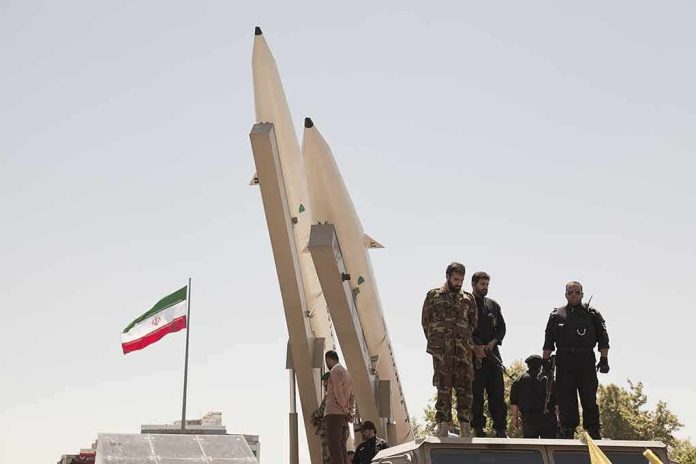
Two Iranian ballistic missiles fell into the sea on Tuesday night and hit nothing. Hours later the United Arab Emirates halted all trade, commercial exchange and financial transactions with Iran until further notice.
The missiles were not aimed at the Emirates. The UAE Defence… https://t.co/wJBrn6AMNm pic.twitter.com/ht6lmE3D7l
— Shanaka Anslem Perera ⚡ (@shanaka86) August 18, 2026
What to watch next: the metrics that will actually move the needle
Reading Iran’s trajectory requires discipline—focus on measurable stressors that map to institutional capability. Four deserve sustained attention. First, the labor and logistics ledger inside IRGC-linked enterprises: construction conglomerates, energy interfaces, and defense industrial plants. Persistent unpaid wages or spare-part shortages would affect readiness in ways rhetoric cannot repair. Second, the tempo and geography of protests relative to security deployments: if unrest persists despite lethal deterrence and deployments appear thinner or slower to respond, that signals strain.
Third, the succession file: credible documentation of paralysis or open breaches among clerical and security elites would matter more than rumors about personalities. Finally, the carceral map: arrest, transfer, and execution patterns reveal whether the system is clearing caseloads or drowning in them. Here, human-rights documentation—while produced under duress and with inevitable gaps—remains one of the few consistent windows into the scale of domestic control operations.
The bottom line
Something is wearing down the IRGC, but it is not a single clandestine campaign delivering clean decapitation. It is the arithmetic of governing through permanent crisis: inflation that makes every basket of goods a grievance, protests that stretch the map, a succession struggle that concentrates power while narrowing options, and a security posture that must deter abroad and dominate at home. The open record supports stress and centralization; it does not support near-term institutional collapse. In the politics of endurance, that distinction matters. Institutions fail slowly, then suddenly; Iran’s security state, for now, is still in the slow part.
Sources:
youtube.com, en.wikipedia.org, amnesty.org, reuters.com, hrw.org