A federal mistrial where 10 jurors rejected the case, yet the judge jailed the suspect and ordered a retrial, is raising deep questions about government power and evidence in the Palisades Fire arson case.
Story Snapshot
- Ten of twelve jurors said the government failed to prove guilt, but the judge still set an October retrial and kept the suspect in jail.[1][3][6]
- Prosecutors leaned on ChatGPT logs, political anger, and a grill lighter instead of direct evidence that he lit the first blaze.[1][4][7]
- Defense experts said fireworks likely sparked the fire, and attacked sloppy scene handling and missing forensic proof.[7][15]
- The case shows how circumstantial “arson science” and digital diaries can be used to build life‑ruining charges with thin proof.[5][17][18]
Deadlocked Jury, Yet Judge Orders Retrial And Jails Suspect
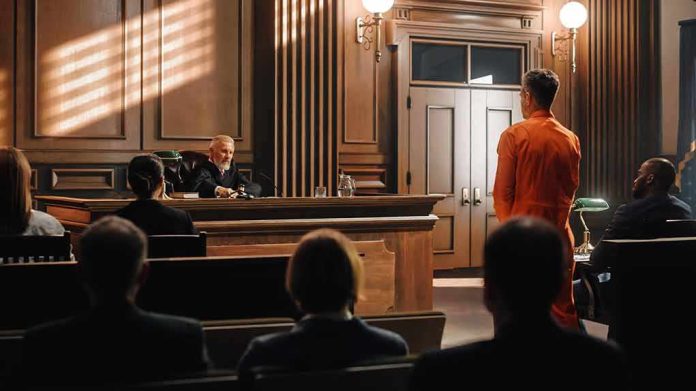
Ten out of twelve jurors in the federal trial of Jonathan Rinderknecht, accused of sparking the deadly 2025 Palisades Fire, voted not guilty, saying the government did not prove its case.[1] The panel reported it was “hopelessly deadlocked,” with two jurors refusing to change their view, forcing Judge Anne Hwang to declare a mistrial.[3] Despite that strong split in favor of acquittal, the judge quickly set a new trial date for October 19 and ordered Rinderknecht jailed until then.[1]
Defense attorney Steve Haney said his client was encouraged that so many jurors “resoundingly found that the government’s case was not strong.”[3] Yet Rinderknecht still faces up to 45 years in federal prison if prosecutors win at retrial.[5] For many observers, this feels like the government getting a second bite at the apple after failing to convince most of a citizen jury the first time, raising due process and fairness concerns, especially when liberty is at stake for months before a second trial.[5]
Government Case Built On Anger, ChatGPT, And A Grill Lighter
Federal prosecutors never produced direct evidence that Rinderknecht actually lit the initial New Year’s Day Lachman Fire that later fed the Palisades blaze.[1] Instead, they told jurors he was near the remote trail when the fire started and argued that his phone and online history showed deep anger at the wealthy and thoughts of revenge against society.[3] Agents pointed to his searches about Luigi Mangione, an accused killer of a health‑care chief, and a Reddit query reading “lets kill all the billionaires” to paint a picture of class resentment.[3]
Investigators also pulled thousands of ChatGPT conversations, saying Rinderknecht used the tool as a digital diary several times a week.[2] In those logs, he asked, “Why am I so angry all the time?” and speculated about someone hypothetically starting a fire in the Palisades out of frustration over inequality.[2] Prosecutors said a green grill lighter found in his rented car tied that motive to a means, claiming he used it to ignite brush near the upscale Summit neighborhood.[7] The case shows how political anger and private digital speech can be turned into evidence of intent, even when no one saw a match struck.
Defense: Fireworks, Flawed Forensics, And Behavior That Looks More Like A Witness Than An Arsonist
The defense hit hard at gaps in the government’s proof. Haney argued there was “no direct evidence at all” that his client maliciously started the fire, only attacks on his character.[5] A veteran fire expert for the defense testified that fireworks were the most likely cause of the Lachman Fire, not a grill lighter used by an angry vigilante, giving jurors a simple alternative that fit the lack of accelerant or device evidence.[15] Defense witnesses also said the origin scene sat unsecured for 13 days, risking contamination and undermining any later forensic claims.[15]
Rinderknecht’s behavior on the night of the fire also cut against the usual arson pattern. He called 911 more than a dozen times and stayed on scene while firefighters battled the flames, recording video and asking ChatGPT whether someone would be responsible for an accidental cigarette fire.[2] Haney told reporters that an arsonist normally lights the blaze and flees, not repeatedly call for help and remain nearby.[2] Under long‑standing arson law, juries are told circumstantial evidence can convict, but it must clear the “beyond a reasonable doubt” bar; the 10–2 split suggests most jurors felt the government had not reached that standard.[17]
Arson Science, Digital Evidence, And The Power Of The State
The Palisades case fits a broader trend in modern arson trials, where investigators rarely have direct proof such as clear video of ignition or a witness who saw the suspect start the fire.[18] Instead, they rely on fire‑scene patterns, expert opinions, and circumstantial clues about motive and opportunity.[18] Legal scholars have warned for years that flawed fire science and loosely interpreted burn patterns can lead to wrongful convictions, especially when scenes are not quickly secured and tested.[19] Here, the long delay before locking down the origin area gave the defense room to argue that “science” was leaning on shaky ground.[15]
A mistrial was declared today in the trial of Palisades Fire arson suspect Jonathan Rinderknecht. After initially indicating it had reached a verdict, the jury announced Thursday it was unable to reach a unanimous decision, telling the judge the panel was at a “standstill".
— John Burtis (@burtis_john) June 27, 2026
The heavy use of ChatGPT logs also raises hard questions about privacy and free thought. Investigators combed through thousands of messages to pull out the most extreme and angry lines, then used them to argue intent.[2] For many conservative readers, this looks like the federal government turning online venting into a weapon, blurring the line between dark thoughts and criminal acts. When a man can be held for months and retried mainly on circumstantial “science” and mined digital diaries, the stakes for constitutional protections, limited government, and fair trials could not be higher.[18]
Sources:
[1] YouTube – 10 of 12 jurors say Palisades Fire suspect isn’t guilty. Now he faces …
[2] Web – Palisades Fire suspect Jonathan Rinderknecht heads to trial – CNN
[3] Web – A deadlocked jury in the Palisades Fire trial leaves attorneys …
[4] Web – Judge declares mistrial in Palisades Fire suspect’s federal trial
[5] Web – Mistrial declared after jury deadlocks in arson trial over deadly 2025 …
[6] Web – United States v. Jonathan Rinderknecht – Department of Justice
[7] Web – Mistrial declared after jury deadlocks in arson trial over deadly 2025 …
[15] Web – Jurors deadlocked in arson trial of Palisades Fire suspect
[17] Web – Mistrial declared after jury deadlocks in arson trial over deadly 2025 …
[18] Web – [PDF] Circumstantial Evidence in Arson Cases – Scholarly Commons
[19] Web – Arson Defense: Why the Fire Investigation Is the Whole Case