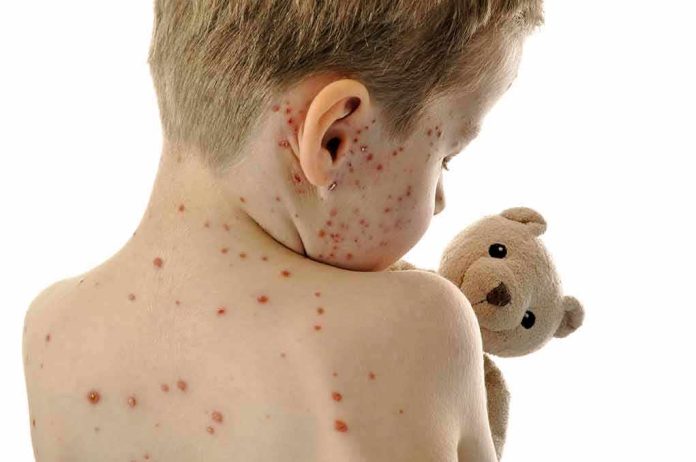
Measles does not need much help to spread; give the virus a gap in immunity and it will take an entire state for a ride. Pennsylvania’s 2026 outbreak shows, in unforgiving detail, how small erosions in vaccination coverage can turn a containable spark into a statewide crisis—measured in hundreds of hospitalizations, multiple deaths, and cascading operational strain on health systems.
At a Glance
- Pennsylvania’s Department of Health documented a rapidly expanding measles outbreak across dozens of counties, with confirmed cases rising weekly through late September 2026 and hospitalizations mounting in parallel.
- Officials tied the outbreak’s severity to immunization gaps and vaccine hesitancy, while deploying pop-up clinics and urging earlier MMR dosing for infants in high-risk settings.
- Five measles-associated deaths were announced by September 30, underscoring clinical severity; some federal-state differences in death attribution language did not alter the need for aggressive control.
- Hospitals converted rooms for airborne isolation as measles overwhelmed normal capacity—evidence that even brief drops below herd-immunity thresholds carry outsized system costs.
What the outbreak looked like on the ground: scale, spread, and severity
By mid-September 2026, Pennsylvania’s Department of Health (DOH) reported a statewide measles count in the high hundreds, with spread recorded in more than three dozen counties. The official updates trace a clear trajectory: 676 confirmed cases on September 11, 731 on September 16, and 835 on September 23, before reaching 943 by September 30. Hospitalizations climbed from 124 to 176 over the same period, a burden that pressed hospitals to expand airborne isolation capacity and reorganize patient flow. State reporting and national coverage were broadly concordant: what Pennsylvania documented, major outlets echoed, including totals and the geographic breadth of transmission.
Case counts in outbreaks always move—epidemiology does not pause for publishing cycles—so weekly updates are the correct lens. But the pattern was not subtle: this was sustained, multi-county transmission with significant clinical impact. The state also confirmed five measles-associated deaths by September 30. While the Centers for Disease Control and Prevention (CDC) used more cautious phrasing for some of those deaths pending reviews, the core reality did not change: Pennsylvania was managing a lethal vaccine-preventable disease at scale.
Mechanism: why a small coverage gap fuels a big measles outbreak
Measles is engineered by evolution to exploit vulnerability. The virus’s basic reproduction number (R0) is so high that communities need roughly 95% immunity to halt sustained spread—a bar not met in pockets of Pennsylvania. Officials repeatedly linked outbreak growth to under-vaccination and hesitancy. The state’s September 23 update paired epidemiology with action: nearly 5,200 MMR doses administered via 156 pop-up clinics, a response premised on the same principle that achieved measles elimination in 2000—restore the immunity wall, transmission collapses.
Experts have warned for years that statewide vaccination averages mask local risk. Clusters of schools or neighborhoods slipping below the 95% threshold are enough to sustain spread across social networks and counties. That pattern was visible in reporting around Pennsylvania’s outbreak and is consistent with national data showing how even modest declines in MMR uptake expand the pool of susceptibles, particularly among young children and unimmunized adults who bridge transmission into workplaces, healthcare settings, and congregate living.
Clinical and operational consequences: from isolation rooms to infant risk
The clinical arc of measles—high fever, cough, coryza, conjunctivitis, then rash—belies its complications: pneumonia, encephalitis, and immune amnesia that raises susceptibility to other infections. Pennsylvania’s hospitalization counts narrate the severity more starkly than any symptom list. Hospitals in the hardest-hit areas retrofitted rooms for airborne infection isolation, a nontrivial conversion that displaces other care and consumes staffing slack in a system already conditioned by years of surge planning.
Infants and immunocompromised patients face the highest stakes. Because MMR is a live attenuated vaccine, it is contraindicated in pregnancy, leaving newborns uncovered if maternal immunity is absent. In this context, Pennsylvania’s recommendation to accelerate first MMR doses to as early as six months for infants in high-risk settings is textbook outbreak control—an evidence-based deviation from the standard 12-month first dose that prioritizes near-term protection during active transmission.
Counting deaths in real time: classification language versus response imperatives
The state announced five measles-associated deaths by late September, using criteria that encompass cases where measles plausibly caused or contributed to mortality. CDC communications around two of those deaths were more guarded, reflecting federal review protocols that can lag state investigations. That divergence—visible in national coverage—matters for record-keeping and retrospective analysis, but it does not reshape the public-health imperatives during an ongoing outbreak: break chains of transmission, protect the unprotected, and keep hospitals functional.
These definitional seams are not unique to measles; they surface whenever rapid surveillance meets the slower cadence of death-certificate coding and federal confirmation. The throughline for the public is simpler than the bureaucracy: a vaccine-preventable virus caused large-scale illness and hospital strain in Pennsylvania, and officials moved to restore community immunity while investigating outcomes rigorously.
What worked, what did not: interventions and their logic
The state’s toolkit matched the pathogen. First, expand vaccination access—hence the pop-up clinics and outreach into communities with known coverage gaps. Second, modify guidance for the exposure context: early infant dosing in high-risk areas, accelerated second doses where appropriate, and strict healthcare triage protocols so symptomatic patients do not seed emergency departments. Third, request federal technical assistance—CDC field teams, lab support, and communications backstops—when containment becomes a multi-jurisdictional exercise.
These measures reflect decades of outbreak playbooks: when R0 is high and generation intervals are short, timing is everything. Vaccinate before exposure where possible; if not, cut contact opportunities, especially in schools and healthcare facilities. Pennsylvania’s weekly reports suggest this posture—prevention by restoring herd effects—was central to bending the curve, even as counts rose through September.
Pennsylvania measles cases pass 1K mark amid outbreak
Measles had been declared eliminated in the U.S. in 2000. Vaccine-deniers brought it back. https://t.co/OScdbgynvc
— David Sydow (@DavidSydow12) October 6, 2026
Why this matters beyond Pennsylvania
Measles elimination in the United States has always been contingent, not ordained. The virus disappears when communities maintain the 95% immune wall and reappears where that wall thins. National and international surveillance show the same relationship year after year: when MMR uptake sags, outbreaks scale—first locally, then across networks of travel, school, and healthcare. Pennsylvania’s experience is a case study in the consequences of letting small cracks widen: the cost is paid in pediatric wards and ICU shifts, not in abstract charts.
Sources:
pa.gov, nytimes.com, inquirer.com, abcnews.com, aad.org, cbsnews.com