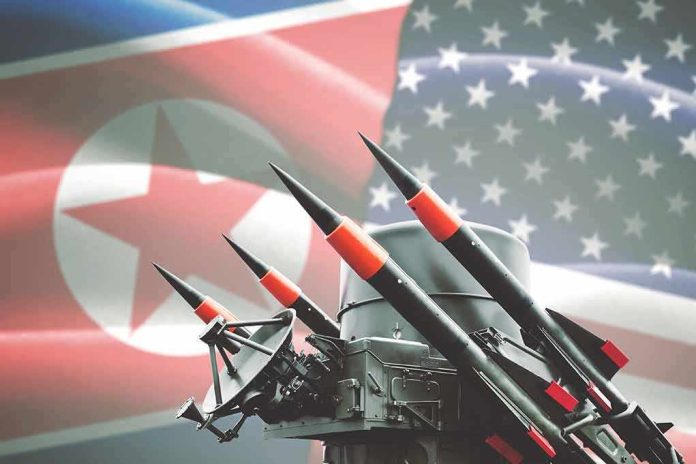
When a leader promises to turn a coastal-defense fleet into a nuclear-armed navy and names the hulls to carry it, he is not merely posturing; he is publishing a program. In June 2026, Kim Jong Un did exactly that, tying North Korea’s naval future to nuclear weapons and larger surface combatants in a speech delivered at a warship commissioning—an unusually concrete signal in a domain where ambiguity is often the point.
The Short Version
- Kim Jong Un publicly vowed to equip North Korea’s navy with nuclear weapons and build larger warships, anchored by a commissioning-ceremony speech in June 2026.
- The pledge included tangible targets: two new surface ships annually for five years and development of a 10,000-ton-class cruiser.
- Multiple outlets reported the vow contemporaneously, grounding it in a real event rather than an abstract policy note.
- The move extends a years-long modernization arc aimed at sea-based nuclear deterrence across submarines and surface combatants.
What Kim Announced, and Why the Setting Matters
On June 24, 2026, at the western port of Nampho, Kim Jong Un presided over the commissioning of the 5,000-ton Choe Hyon-class destroyer and used the ceremony to set a strategic marker: North Korea, he said, will equip its navy with nuclear capabilities and accelerate the construction of larger warships, including a 10,000-ton cruiser. He set a cadence—two new surface ships per year for five years—framing naval nuclearization as a planned, sequential effort rather than a vague aspiration. The remarks were carried by state media and rapidly amplified by major international outlets that converged on the same core claims, making the pledge both public and specific in time and place.
The ceremony context is not incidental. Pyongyang has long used high-visibility inductions and parades to telegraph doctrine and deterrent posture. By tying a nuclear-armed navy to the tangible artifact of a new destroyer, Kim fused narrative with materiel, signaling that naval modernization is now a principal vector for projecting nuclear deterrence at sea.
The Programmatic Spine: Tonnage, Tempo, and “Nuclear-Armed” Ambition
Three elements define the announcement’s programmatic spine. First, force structure: the 5,000-ton Choe Hyon is positioned as a stepping stone to a 10,000-ton-class “strategic cruiser,” a displacement tier that, if realized, moves the fleet from green-water emphasis toward blue-water signaling. Second, production tempo: two surface ships annually for five years implies a sustained yard rhythm and a pipeline of hull, mechanical, and electrical components sized to large-combatant builds. Third, armament: a navy “equipped with nuclear weapons,” an explicit departure from framing nuclear deterrence as exclusively land- or submarine-based.
These statements align with earlier guidance. In March 2025, Kim called for “radically bolstering” naval combat power and fielding “a large number of modern warships,” placing shipbuilding at the center of force development. The June 2026 vow thus reads as the operationalization of a year-old direction rather than a rhetorical lurch.
How It Fits the Arc of North Korea’s Sea-Based Deterrence
North Korea’s pursuit of a sea-based nuclear option is not new. Over the past several years, Pyongyang has iterated on submarine-launched ballistic and cruise missile concepts, floated a tactical nuclear-attack submarine narrative, and showcased surface ships with vertical launch cells. The modernization arc has gradually broadened from underwater platforms toward surface combatants, a pattern visible in open-source assessments and defense-analytic reporting that treat the naval vector as a complement—not a replacement—to the country’s land-based missiles.
What June 2026 added is a public synthesis: a top-level instruction to fuse nuclear armament with naval expansion, framed as a five-year shipbuilding program and tied to specific displacement classes. That conjunction matters; it directs planners, justifies procurement, and signals to adversaries that maritime nuclear delivery is part of Pyongyang’s long-term deterrent calculus.
Mechanisms and Plausible Pathways: From Speech to Steel
Nuclear-armed surface warfare can take several forms, each with different technical and doctrinal demands. The most straightforward pathway for North Korea is to adapt ship-launched, nuclear-capable cruise missiles—already a focus of testing and state-media messaging—to vertical or inclined launchers aboard large surface combatants. This approach leverages existing missile families and avoids the far steeper challenges of naval nuclear propulsion. The Choe Hyon’s size, and references to even larger cruisers, suggest volume and stability for multi-mission vertical launch systems, sensors, and command spaces consistent with a standoff, missile-centric concept of operations.
Command-and-control is the other pillar. A credible sea-based nuclear role relies on robust positive control and failsafe mechanisms—assured communications, procedural rigor, and physical safeguards—to prevent unauthorized use while preserving rapid employment if ordered. North Korea’s doctrine, as presented publicly, emphasizes centralized authority; embedding that control logic into distributed sea platforms is the doctrinal lift implied by “equipping the Navy with nuclear weapons.” It is precisely why leadership-level statements matter: they greenlight the organizational and technical adaptations this integration requires.
Where This Leaves the Region: Strategic Effects and Countermoves
Maritime nuclear signaling reshapes risk more than it changes raw balance. Compared to fixed launchers, sea-based systems complicate an adversary’s surveillance and targeting problem; they also multiply escalation pathways at sea, where misperception and compressed timelines already challenge crisis control. For South Korea and Japan, a North Korean surface fleet with nuclear-armed cruise missiles would require broader-area maritime domain awareness, more persistent anti-submarine and anti-surface patrols, and enhanced defenses against low-altitude, sea-skimming threats. For the United States and its allies, it widens the deterrence and denial portfolio beyond the Peninsula’s land corridor to the littorals and adjacent seas.
The announcement also interacts with allied procurement trajectories. Seoul’s evolution toward more capable blue-water assets—and its separate debate on undersea propulsion—was already underway; Pyongyang’s public commitment to nuclear-armed surface ships will reinforce arguments for deeper air and missile defense integration, expanded Aegis coverage, and continuous patrol cycles tuned to cruise-missile warning rather than ballistic-only cues.
🇰🇵 North Korea commissions its 2nd nuclear-capable destroyer, Kang Kon — showcase and skepticism in equal measure
North Korea commissioned the Kang Kon (hull 52), a 5,000-ton guided-missile destroyer, at a ceremony in Wonsan on Sunday, Sept. 6, with Kim Jong-un and his daughter… pic.twitter.com/eMGes0u7ik
— 🔥🗞The Informant (@theinformant_x) September 7, 2026
Continuity, Not Whim: Why the Vow Is Credible as Policy Direction
The June 2026 statements were not a trial balloon. They were delivered at a commissioning, echoed by multiple outlets, and repeated in subsequent state-media formulations that described the navy’s transformation into a nuclear-armed force as a strategic course. That continuity tracks with a decade of incremental steps toward maritime nuclear options—initially underwater, increasingly atop surface hulls—and with a leadership style that uses major unveilings to lock in bureaucratic focus.
One cautionary sentence belongs in any sober reading: intent statements do not certify specific capabilities on a given hull. But they do set priorities, budgets, and timelines. In defense planning, that is the essence of momentum. North Korea has now placed its navy squarely inside its nuclear deterrence narrative, with named ship classes and annual targets to carry that story forward.
What to Watch Next: Indicators That the Program Is Advancing
Three families of indicators will show whether the speech is hardening into force. First, yard tempo and displacement: repeat appearances of Choe Hyon-class or larger hulls in commercial satellite imagery, visible dry-dock activity at Nampho, Wonsan, and Sinpo, and launch/commissioning cycles that approach the promised two-per-year rhythm. Second, weapons integration: at-sea tests of ship-launched cruise missiles with ranges and profiles consistent with nuclear-capable variants, as well as deck plans and superstructure modifications aligned with expanded vertical launch capacity. Third, doctrine and training: more complex fleet exercises, communications drills, and state-media footage emphasizing nuclear command themes aboard surface combatants.
Sources:
feedpress.me, france24.com, cnn.com, independent.co.uk, en.yna.co.kr, japantimes.co.jp, straitstimes.com, presstv.ir