
In campaigns where identity and national security anxieties run hot, the sharpest disputes are rarely about what voters already know; they turn on what can be proven, what is merely alleged, and how partisans blur that boundary to win the moment.
At a Glance
- The hidden-camera clip with Rep. Rashida Tlaib is evidence of her stance, not proof of the underlying claims about Abdul El-Sayed’s citizenship or extremist ties.
- The strongest documented facts: El-Sayed once signed a 2012 statement defending Egypt’s then-president Mohamed Morsi and has made conflicting statements, via reporting, about dual citizenship.
- Independent fact-checks and local outlets report no evidence that El-Sayed belongs to, pledged support to, or materially aided the Muslim Brotherhood or terrorist groups.
- Family and organizational associations carry far less evidentiary weight than direct records; treating them as equivalent is how accusation politics thrives.
What the video shows — and what it doesn’t
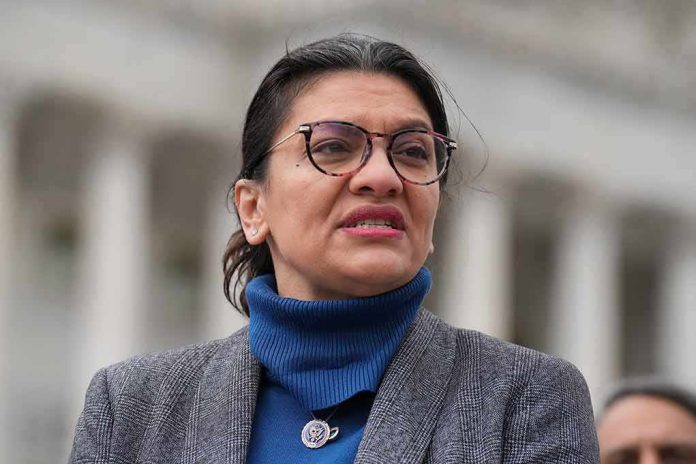
The undercover recording featuring Rep. Rashida Tlaib has been framed as a bombshell because she reportedly downplayed whether Abdul El-Sayed might hold an Egyptian passport and dismissed claims about Muslim Brotherhood links. That clip, however, proves only that Tlaib chose to minimize the allegations in conversation; it does not authenticate the claims themselves. According to coverage, she said an Egyptian passport “doesn’t matter” and that El-Sayed was “obviously” not a terrorist — positions that speak to her political judgment and frame, not to documentary verification of citizenship or organizational membership. For voters and analysts alike, the video is an exhibit about rhetoric, not records.
The strategic effect is familiar: a vivid exchange becomes the focus, while the underlying questions — what documents exist, what official bodies have found — risk getting lost. When a campaign or surrogate treats doubt as dispositive or outrage as evidence, the audience is left with a feeling rather than a file.
The verifiable spine: what is documented in this case
On the evidentiary merits, several points are firm. First, El-Sayed did sign a November 2012 statement defending Mohamed Morsi, then Egypt’s president and a figure linked to the Muslim Brotherhood. That is a matter of record and has been reported by multiple outlets; it demonstrates a political position in that moment, not organizational membership or material support. Second, reporting has highlighted an inconsistency: El-Sayed was previously described as acknowledging dual Egyptian-U.S. citizenship, then denied being a dual citizen when later pressed; the campaign now characterizes the earlier statement as an error and maintains he “is not a dual citizen by any verifiable metric”. These are tangible contradictions that invite clarification through documents.
Other pieces of the case are far less sturdy. Allegations about a relative’s activism in Egypt in the 1970s rest chiefly on a half-sister’s social-media posts — a meager foundation without independent corroboration, names of contemporaneous witnesses, or archival records. Assertions tethered to El-Sayed’s father-in-law’s roles in U.S. Muslim civic organizations likewise suffer from the classic association fallacy: even if those organizations were cited as unindicted co-conspirators in a past case, that says nothing direct about El-Sayed’s personal conduct, finances, or beliefs.
What the counter-evidence establishes
On the core and most serious allegation — that El-Sayed is tied to the Muslim Brotherhood or terrorism — independent fact-checks and regional reporting converge: they have found no evidence of membership, pledge of support, or material aid. PolitiFact reported that El-Sayed, a Michigan-born U.S. citizen, is not a Brotherhood member and distinguished his 2012 defense of Morsi from proof of organizational allegiance. BridgeDetroit and Bridge Michigan similarly reported no direct evidence that he pledged support to or belongs to the Brotherhood, noting his repeated denials. His campaign’s position on citizenship has been that he has never been a dual citizen “by any verifiable metric”. Those are specific, named, on-the-record refutations of the broadest charges, and, absent countervailing documents from competent authorities, they carry weight.
Crucially, none of the sources surveyed identify an FBI, Treasury, State Department, court, or intelligence finding that El-Sayed personally belongs to or financially supported a terrorist organization. In allegation politics, institutional silence is not exoneration — but it is a decisive constraint on claims purporting to be proven rather than posited.
How to weigh evidence in “ties” controversies
Disputes like this one recycle the same building blocks: a public statement or signature; family history; organizational proximity; and terminology that collapses distinct entities under a single, emotionally freighted label. An expert reading sorts those blocks by evidentiary weight. Direct records — government filings, passport and registry documents, sworn testimony, financial transfers traced by competent authorities — are top tier. Public political speech (such as a 2012 letter) is second-tier: it establishes a view at a point in time but not membership or operational activity. Family claims and associative links, unless independently corroborated and causally relevant, sit far lower on the ladder. Fusing them all into “ties” may be rhetorically effective; it is analytically unsound.
The Brotherhood itself compounds confusion. Analysts long ago distinguished between the Egyptian parent movement, national branches with varied behavior, offshoots, and armed splinters; U.S. policy has often targeted particular entities rather than designating the entire movement monolithically. Understanding that landscape matters because a signature on a statement about Morsi in 2012 is not the same thing as a membership card in a proscribed organization, let alone material support to terrorism.
What would actually resolve the live questions
Two questions are resolvable with documents. First, the citizenship discrepancy: if El-Sayed at some point held, or currently holds, Egyptian citizenship, the path to clarity runs through authenticated Egyptian civil-registry or passport records, prior renunciation filings if any, and any U.S. disclosures where foreign nationality must be reported. Producing those records — or a credible explanation of the earlier reported statement with documentation from custodians of record — would settle the matter. Short of that, the inconsistency remains an open credibility problem, not proof of dual status.
Second, the terrorism/Brotherhood allegation: absent a competent authority’s finding or documentary trail of membership dues, meetings, communications, or financial transfers that meet legal thresholds for material support, the charge does not graduate from insinuation to evidence-backed fact. Fact-checks have said as much, and until a concrete record surfaces, that is where the evidentiary line stands.
Jesse confronted AES over Black voters in Michigan.
El-Sayed fired back: “I was outspent 11 to 1.”
Then called Mike Rogers a “beta” who won't debate him.
Watters: “I didn’t agree to that, but that’s funny.”
Even Watters couldn't resist laughing. pic.twitter.com/VdyBetxiDE
— Dr Ahmad Rehan Khan (@AhmadRehanKhan) October 28, 2026
Why the Tlaib clip still matters — and how to read it
The Tlaib video matters because it illustrates a campaign instinct that often backfires: collapsing disputes about facts into arguments about fairness. Her suggestion that an Egyptian passport would draw disproportionate scrutiny compared with a French passport is a political critique of double standards, not an answer to whether the document exists or whether dual nationality would implicate legal or ethical considerations for a candidate. When surrogates substitute grievance for verification, they can energize allies while alienating persuadables who want clean answers to clear questions. The clip is thus best read as a cautionary tale: handle verifiable claims with verifiable records, and treat association logic with skepticism.
Sources:
hotair.com, townhall.com, thehill.com, politifact.com, nrsc.org, bridgedetroit.com, yahoo.com, washingtontimes.com, ground.news