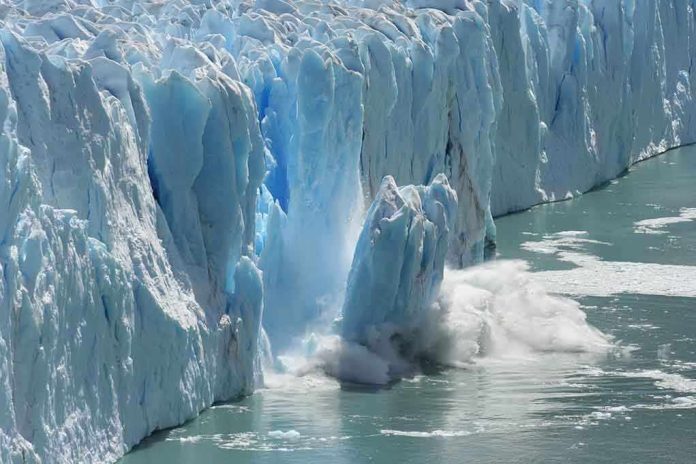
The emerging science argues that Greenland’s meltwater is not just a sea‑level story; it is a seasonal steering wheel for Europe’s summer climate, with a repeatable ocean‑to‑atmosphere chain that nudges the jet stream toward patterns favoring heat and drought across the continent.
The Short Version
- Observations link winters with large North Atlantic freshwater anomalies to hotter, drier European summers months later.
- The ten hottest and driest European summers of the past four decades followed especially large Greenland freshwater releases.
- Mechanism: freshening sharpens winter sea‑surface temperature gradients, destabilizes the overlying atmosphere, and shifts circulation over Europe toward heatwave‑prone regimes.
- Models often mute this pathway, suggesting current projections may understate summer heat risk if they misrepresent localized freshwater influx.
What the mechanism actually is: from Greenland runoff to European ridges
Freshwater entering the subpolar North Atlantic from Greenland ice melt and Arctic sources reduces surface salinity. In winter, when the ocean–atmosphere heat exchange is vigorous, that freshening sharpens the temperature contrast (“front”) between the colder subpolar waters and the warmer subtropics. A steeper sea‑surface temperature front modifies atmospheric instability and the storm track overhead, altering the latitude and strength of the North Atlantic Current and, in turn, the downstream jet that governs European summer circulation. The peer‑reviewed analysis that put this sequence on a quantitative footing shows that winters with stronger freshwater anomalies are followed by summers in Europe that are statistically warmer and drier, consistent with more frequent high‑pressure blocking and heatwaves.
This is not a vague teleconnection. It is built from observations and reanalysis, not just a model vignette: the paper ties wintertime ocean conditions—specifically the freshwater and temperature‑front structure—to a predictable atmospheric response in the subsequent summer, and it documents that relationship across the multi‑decadal record.
How we know: the empirical pattern and why it matters for planning
Two elements give the finding practical bite. First, the lag. Because the freshwater and temperature‑front signals emerge in winter, they provide months of lead time going into the European warm season. Second, the pattern has teeth: reporting based on the underlying analyses highlights that the ten hottest and driest European summers in roughly forty years all came after outsized Greenland freshwater release events—a concrete, falsifiable statistic that separates this signal from background noise. For water managers, grid operators, and agriculture, a reliable springtime heads‑up about an elevated probability of summer ridging has clear value; it shapes reservoir strategy, heat‑health readiness, and crop choices.
Institutional summaries converge on the same chain—freshening, sharpened winter fronts, circulation shifts, and European heat extremes—underscoring that we are not dealing with an isolated claim but an emerging consensus on mechanism, pending continued stress‑testing.
What remains unsettled: causality boundaries and model fidelity
No single factor “causes” a European heatwave. Background anthropogenic warming, land–atmosphere feedbacks (particularly soil‑moisture depletion), internal atmospheric variability, and blocking dynamics remain primary drivers. The Greenland freshwater pathway sits upstream, modulating the odds by pre‑conditioning the jet and storm track. That nuance matters: the recent literature establishes a robust statistical link and lays out a physically plausible conduit, but it is not a full formal attribution that isolates meltwater’s fractional contribution event by event. The lead paper itself frames the relationship as observational and reanalysis‑based rather than an end‑to‑end counterfactual attribution with “with‑and‑without” meltwater experiments.
Models are the other pressure point. Several teams report that standard CMIP‑class models under‑resolve localized freshwater injections and thus damp the cascading response from the subpolar front into European summer circulation. In plain terms: if a model diffuses away the very freshwater contrasts that drive the mechanism, it will understate the teleconnection and the associated heat risk. An EarthArXiv analysis articulates this critique directly, arguing that mainstream models cannot yet simulate the sequence faithfully, which implies projections may be conservative about future summer extremes if this process strengthens with continued melt.
AMOC isn’t the fulcrum here—and that’s important
Public debate tends to fold any North Atlantic freshening into dramatic scenarios about an abrupt AMOC collapse. The Greenland–Europe heatwave pathway does not require an AMOC tipping event. In fact, recent modeling and review work points to a middle ground: added Greenland meltwater exacerbates greenhouse‑gas‑driven AMOC weakening later this century, but across multi‑century simulations the changes are neither abrupt nor irreversible in the presence of meltwater forcing alone. That finding is not a dismissal of risk; it is a boundary condition. It says the seasonal jet‑stream preconditioning relevant to European summers can operate without invoking a wholesale reorganization of the overturning circulation.
This distinction protects the practical value of the freshwater–heat link from the unresolved, slower‑moving AMOC debate: you can exploit the winter signal to anticipate summer hazards even as the centennial trajectory of the overturning remains scientifically contested.
Signal versus noise: how to judge the strength of the case
Three lines of evidence support taking the mechanism seriously in operations while continuing to scrutinize it in research. First, specificity: the pathway quantifies winter freshwater anomalies, winter oceanic fronts, and a summer atmospheric response—named, dated, and measurable variables rather than post‑hoc composites. Second, asymmetry: the empirical “ten hottest and driest summers” statistic indicates a directional influence consistent with a causal chain rather than coincidental alignment. Third, independent articulation: coverage by research institutions and science outlets describes the same steps from subpolar freshening to jet‑stream modulation and European heat, reducing the risk that the finding is an artifact of a single team’s methods.
Against this, the strongest cautions center on model limitations and the shortness of certain direct ocean records. Even proponents acknowledge that conventional models struggle with localized freshwater fluxes; skeptics point to the uncertain partitioning between the North Atlantic “cold blob” dynamics and Greenland meltwater specifically. These are legitimate, tractable issues—addressable through higher‑resolution ocean components, explicit runoff schemes, and targeted hindcasts that test out‑of‑sample predictive skill.
Greenland meltwater is intensifying European heatwaves
The cooling of the North Atlantic is creating waviness in the jet stream and high-pressure ridging over Europe, a study findshttps://t.co/gep7rx2NABhttps://t.co/CklzJMBwu2 pic.twitter.com/iX1oGPHeHI
— David Ullrich (@DavidUllrich202) August 21, 2026
What to do with this knowledge: a practical playbook
If you are responsible for summer risk in Europe—energy balancing authorities, municipal heat coordinators, crop insurers—the prudent approach is to treat winter freshwater and subpolar front diagnostics as a conditional risk amplifier. Ask three questions each spring: How anomalous is the freshwater content of the subpolar gyre? How sharp is the winter sea‑surface temperature front? Do seasonal forecast ensembles reflect a jet configuration consistent with increased European blocking? If the answers align, elevate summer heat and drought preparedness: stage cooling centers earlier, secure hydropower hedges, update wildfire readiness, and recalibrate irrigation expectations.
For the research community, the to‑do list is clear. Publish full counterfactual attribution with and without realistic meltwater forcing; conduct independent replications with distinct models and observational products; and validate each step of the chain—freshwater flux, front sharpening, jet latitude, blocking frequency—season by season. That is how a promising statistical teleconnection becomes an operational predictor with known uncertainty bounds.
Bottom line
Greenland’s runoff is already large enough to leave a seasonal fingerprint on the North Atlantic and, by extension, on Europe’s summer circulation. The link is strongest where it matters for planning: it offers lead time, it is observable, and it points to specific hazards. Treat it as a skillful precursor signal to be integrated into decisions today, and as an active research frontier whose refinement will determine just how much foresight European societies can count on in a warming world.
Sources:
newscientist.com, courrierinternational.com, gmao.gsfc.nasa.gov, meetingorganizer.copernicus.org, climate.copernicus.eu, woodwellclimate.org, nature.com