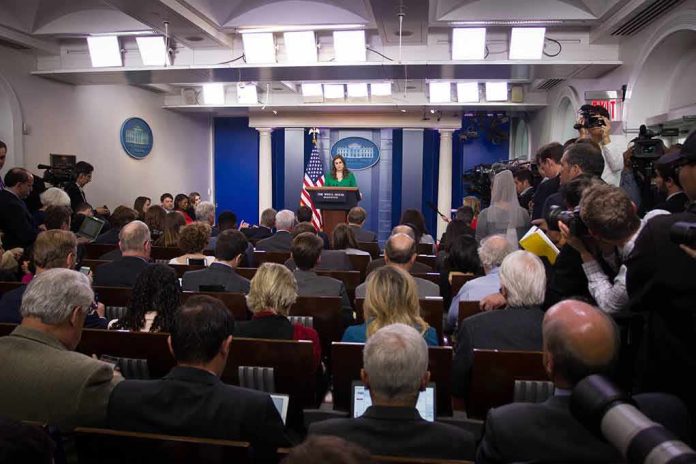
When a White House conditions access on whether reporters flatter or criticize the president, it stops being mere press management and drifts into unconstitutional viewpoint punishment; that is the core stakes in any “ban the outlets” announcement, regardless of the day’s personalities.
At a Glance
- President Trump publicly announced an “effective immediately” ban on CNN, MS NOW/MSNBC, and Politico from the White House, tying it to what he called “constant” fake news.
- The claim that Politico took an “$8 million” Biden-era payout remains an assertion in his posts and remarks, not a documented financial record.
- The scope and mechanism of the ban were initially unclear; contemporaneous accounts contrasted the rhetoric with on-the-ground credential status.
- Recent litigation over Associated Press access sets the legal frame: if the government opens press access, it cannot exclude by viewpoint in those opened spaces.
What was announced and why it matters
President Trump said he was barring CNN, MS NOW/MSNBC, and Politico from the White House “effective immediately,” accusing each of peddling “fake news” and, in Politico’s case, alleging a multimillion-dollar federal infusion under President Biden. The announcement asserted specific rationales and promised “other fake news outlets to follow.” Multiple national outlets captured both the immediacy and the explicitly retaliatory rationale in their coverage, which is why the move was instantly read not as a housekeeping tweak but as a First Amendment fight over whether the executive can dole out access based on editorial stance.
As with any access dispute, the details matter: which doors and which credentials, handled by which office. Early reporting underscored two uncertainties—no formal revocation order was published alongside the declaration, and the administration did not delineate whether this applied to hard passes, pool rotations, or specific rooms and events. CNN, for its part, said its team remained in its assigned workspace after the announcement, highlighting the gap between a broad presidential statement and the granular systems that govern entry to federal property.
Mechanism: how White House press access actually works
Security access to the White House complex is administered by the Secret Service, but the operational architecture of who gets into which room rides on layered practices: long-term hard passes and day passes, press pool rotations organized with the White House Correspondents’ Association, and event-specific lists vetted by the press office. The upshot is practical: the government retains authority to set reasonable, content-neutral rules for restricted spaces, but the First Amendment forbids viewpoint-based discrimination once it opens those spaces to the press as a functional forum for newsgathering.
That is more than civics boilerplate; courts recently applied it to presidential venues. In the Associated Press litigation, a federal district court concluded that once the White House opens the Oval Office, Air Force One, or similar restricted settings to the press pool, it cannot exclude a disfavored outlet because of its viewpoint; the court enjoined viewpoint-based denials as likely unconstitutional, applying the nonpublic forum doctrine’s requirements of reasonableness and viewpoint neutrality. Subsequent appellate activity produced a contested landscape, but the core principle—that access opened to some cannot be shut to others because of their criticism—has been repeatedly recognized in the jurisprudence and by press-freedom advocates assessing these disputes.
Evidence versus assertion in the stated rationale
Two strands in the stated rationale deserve clean separation. First, the administration’s “fake news” label for CNN and MS NOW/MSNBC is a qualitative critique of coverage, not a set of cited errors tied to credentialing criteria. The reporting record assembled here quotes the president’s charge but does not present outlet-specific corrections or adjudicated falsity linked to the ban decision; as such, the justification, as publicly articulated, reads as disagreement with content rather than a rules-based enforcement action.
Second, the Politico funding claim: the allegation of an “illegal” or irregular $8 million federal subscription was reported as the president’s statement, but no contracting records, invoices, or legal justifications surfaced in this evidentiary set to validate it. In access fights, uncorroborated assertions rarely bear the legal weight the government needs to justify exclusion; courts look for written policies and documented, neutral criteria. Until underlying financial documents emerge, this remains a political claim, not an evidentiary foundation for barring a newsroom.
Where the legal fault lines actually are
Presidents have latitude to manage logistics and security—who stands where, how many cameras fit, pool sizes on cramped foreign trips—so long as those limitations are reasonable and not a proxy for penalizing disfavored viewpoints. The AP case turned on that line: the district court found the government likely violated the First Amendment by excluding AP from select venues once those venues were opened to other journalists, emphasizing that nonpublic forums still require viewpoint neutrality. Press-freedom groups framed the same standard: if the government opens access, it cannot discriminate by editorial stance, even as it retains power to set content-neutral, reasonable restrictions.
Applied here, a declared ban “because fake news” is perilous ground. If implemented as a bar from opened press settings, it invites the very viewpoint-discrimination analysis that has repeatedly haunted such efforts. If, instead, it resolves into case-by-case logistics without a formal, consistent rule, the government risks a different problem: arbitrariness without articulated criteria—a thin reed under modern First Amendment scrutiny when news access is at stake.
Banning critical media from the White House because a president dislikes their reporting is not “fighting fake news.” It is an attack on press freedom and a dangerous step towards state-controlled propaganda.
As a European, I find it deeply disturbing to watch America slide…
— Renate Wijma (@RenateWijma) September 18, 2026
Practical implications for readers and institutions
For citizens, the practical question is not whether a favored or disfavored outlet gets an extra camera slot; it is whether the executive branch can curate scrutiny by punishing hostile reporting. That practice degrades the informational checks built into our system; it also tends to backfire, converting an editorial grievance into a constitutional case that drags through months of litigation while the press continues reporting from other vantage points.
How this likely plays out
Historically, outlet bans announced in sweeping terms encounter immediate pushback, followed by one of three outcomes: a formalization that narrows to process-based rules; quiet de-escalation as routine credentialing continues; or litigation testing whether the exclusions occur in opened venues and are viewpoint-based. Given the record in recent cases, the strongest government position emerges when it can point to published, neutral access standards and documented, evenly applied enforcement; the weakest is a naked link between exclusion and content criticism, especially when paired with unverified allegations about a newsroom’s finances.
The through-line remains stable across administrations: the White House can structure access, but it cannot weaponize it against disfavored coverage in spaces it has opened to journalist participation. Sweeping declarations may play to the base; they rarely survive contact with the forum doctrine.
Sources:
youtube.com, variety.com, dailysignal.com, fox17.com, commondreams.org, npr.org, adweek.com, deadline.com, ifs.org