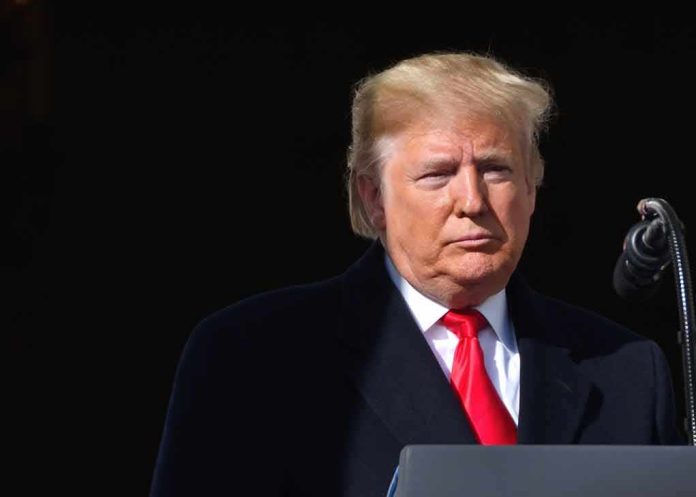
When a president’s overall approval slumps to a career low and a pivotal swing constituency cools at the same time, that is not a blip; it is a governing and electoral problem with policy, communication, and coalition-management roots.
At a Glance
- Reuters/Ipsos finds President Trump’s approval at 32%, matching the lowest of his political career.
- Hispanic approval registers at 24%, the weakest share across his two terms in office, and Democratic advantages on the generic ballot widen in this group.
- The erosion follows earlier gains with Hispanic voters in 2024, underscoring volatility rather than a settled realignment.
- Multiple surveys since 2025 echo the downturn, citing immigration, cost-of-living, and performance judgments as pressure points.
What the latest polling shows, and why it matters
The Reuters/Ipsos survey places Trump’s overall job approval at 32%, unchanged from the prior wave that first established the career low. That topline alone would draw attention in any midterm environment; what makes it consequential is the depth of the softness among Hispanic Americans, where approval sits at 24% — a nadir across both of Trump’s terms, paired with a wide Democratic lead on the generic congressional ballot in this group. In electoral math, the combination matters more than any single number: Hispanic voters are diverse, growing, and decisive in states where House and Senate control routinely turns on narrow margins.
Approval is not the same as vote intention, but the two travel together. Presidential approval functions as a heuristic — a quick read on performance, direction of the country, and whether governing priorities feel aligned with daily life. When approval slumps this far beneath 40%, parties tend to lose persuadables down-ballot unless something else in the environment counteracts it. In that context, a 24% approval among Hispanic Americans is not just an unfavorable reading; it is a headwind with policy and messaging implications for Republicans seeking to defend or flip seats in Hispanic-heavy metros and border regions.
How we got here: volatility after 2024’s gains
The downturn sits atop a recent history of movement rather than stasis. Trump improved his Hispanic vote share in 2024 relative to prior cycles — an achievement documented in post-election analyses and exit polls — and Republicans invested in a durable “realignment” story built on economic aspiration, small-business ownership, cultural conservatism, and perceived toughness on disorder. But the next two years did not freeze those gains in amber. Through 2025 and into 2026, major national surveys recorded declining job approval among Hispanic respondents, with Reuters/Ipsos and Pew each describing comparative weakness on performance ratings, even among some who had supported Trump in 2024.
That arc suggests two features of contemporary Hispanic politics. First, heterogeneity: Cuban Americans in South Florida, Mexican Americans in Texas and the Southwest, Puerto Ricans in the I-4 corridor, and newer Central and South American communities do not respond to a single message or policy bundle. Second, conditionality: shifts that materialize under one economic and policy regime can unwind when pocketbook pressure intensifies or when immigration salience collides with perceived competence. Gains are real; so are reversals.
Mechanisms: policy salience, performance signals, and cost-of-living strain
Why would approval soften this sharply? Start with the economy that households actually experience. Inflation’s cumulative effect, housing costs, and credit conditions typically outrun headline job growth in shaping day-to-day sentiment. When survey respondents say cost of living dominates their political evaluation, they are signaling performance expectations unmet — and approval follows. Polling snapshots tied to this period repeatedly connect Hispanic disapproval to pocketbook strain, even among voters otherwise receptive to Republican themes.
Immigration is the other fulcrum, but not always in the way partisans presume. Hispanic voters routinely hold complex views: favoring border order and lawful processes while resisting rhetoric that feels punitive or dismissive of legal immigrants and mixed-status families. When policy execution looks chaotic — surges without visible control, processing backlogs, or local service strain — blame can fall on the president’s handling rather than on any single ideological stance. Surveys in 2025 and 2026 captured this ambiguity: immigration remained top-of-mind, yet judgments concentrated on performance and outcomes more than slogans, and approval moved accordingly.
Polling, properly understood: what a six-day survey can tell you
Reuters/Ipsos fields large, probability-based national samples and reports subgroup estimates with care. A single six-day wave is still a snapshot, but it is not noise when it replicates earlier readings and aligns with independent research. Here, the 32% overall approval repeats the prior Reuters/Ipsos low, while the 24% Hispanic approval coheres with Pew’s longer-run pattern of elevated disapproval among Latinos during this period and other national outlets’ findings. The cumulative record carries more weight than any isolated data point: multiple polls, over multiple months, pointing to the same direction of travel.
Two technical cautions, neither of which rescues the White House from the underlying signal. First, subgroup estimates come with wider confidence intervals than the full sample; month-to-month wiggle is expected. Second, “approval” is not a ballot test — negative views can soften or reverse under campaign pressure, local issues, or candidate quality. Still, recurring readings in the mid-20s approval range among Hispanic Americans represent a structural warning, not a rounding error.
[Trump approval at record low; Hispanic voters sour on Republicans, Reuters/Ipsos poll]
“Trump's approval rating held at record low in recent days, as many Hispanic voters panned his job performance & planned to spurn his Republican Party in midterm“https://t.co/xXoZrdJZCM
— Norio Nakatsuji (@norionakatsuji) October 6, 2026
Implications for strategy: where Republicans and Democrats adjust
For Republicans, the task is triage and durable rebuild. The 2024 playbook succeeded where economic optimism, public safety, and education choice were salient and credible; it falters when cost-of-living pain and execution doubts on immigration swamp those gains. The remedy is not louder rhetoric but visible competence: price stability as a governing priority, pragmatic immigration administration, and local problem-solving that shows up in family budgets and neighborhood streets. Hispanic outreach that treats communities as partners — Spanish- and English-language media buys, small-business roundtables, and faith-led civic work — must be continuous, not cyclical.
Democrats, for their part, should not confuse Republican weakness with automatic Democratic strength. Hispanic voters punished perceived underperformance before and will do so again. To consolidate advantages suggested by the current polling, Democrats need tangible delivery: housing supply expansion, targeted cost relief that lands quickly, and immigration reforms that pair order with fairness. Messaging layered over slow or symbolic policy will not hold recently restored margins.
What to watch next
Three indicators will tell us whether this trough becomes trend. First, inflation’s trajectory relative to wage growth in Hispanic-dense metros; if real incomes improve, approval can stabilize. Second, operational indicators on immigration — encounter volumes, processing times, and local government strain — which shape competence judgments. Third, district-level polling in Texas, Arizona, Nevada, California’s Central Valley, and Florida; these closer-to-the-ground reads will show whether national approval weakness is migrating into vote intent in the places where House control is decided. Taken together, they will reveal whether the present polling represents a floor or a new normal.
Sources:
feedpress.me, reuters.com, aljazeera.com, usatoday.com