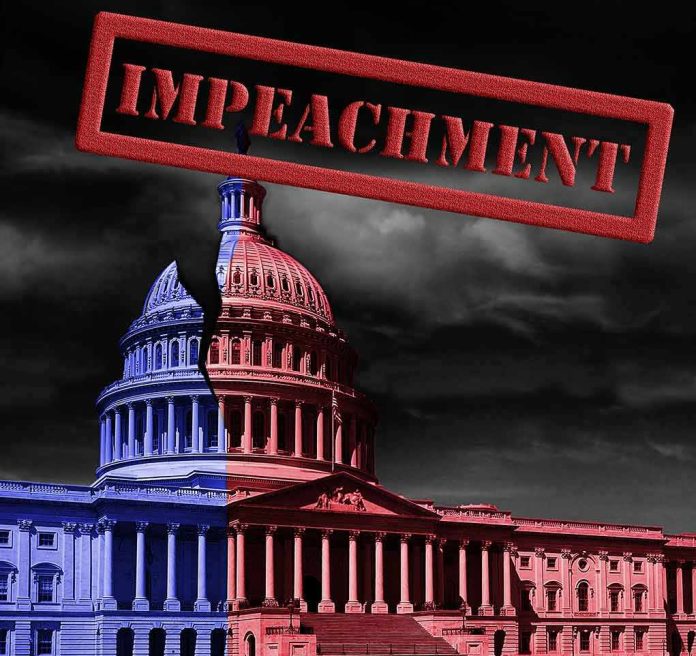
Impeachment talk is often more signal than solution: it sharpens partisan lines, consumes congressional oxygen, and rarely changes who occupies the Oval Office—so a president who projects indifference to impeachment is reading the leverage correctly, even if the rhetoric is combative.
The Short Version
- President Trump publicly said he is “not even a little bit” concerned about Democrats impeaching him and argued it would damage Democrats politically more than him.
- Democratic leaders signaled aggressive oversight but stopped short of committing to impeach, reflecting both political caution and historical limits of impeachment as a removal tool.
- History shows impeachment is a constitutional check that seldom removes presidents and can carry unintended political consequences for both parties.
- If pursued, impeachment would function as an investigative megaphone and leverage engine—not a reliable path to conviction in the Senate.
Trump’s posture and the political calculus behind it
After Democrats’ electoral gains, Trump dismissed the prospect of impeachment, saying he was “not even a little bit” concerned and suggesting such a move would “destroy the Democrat Party.” The bravado is familiar, but the underlying calculation is straightforward: absent a supermajority in the Senate, impeachment is unlikely to remove a president, and the process can galvanize a targeted leader’s coalition while forcing the opposition to spend time and political capital proving a case to a polarized country. Trump’s framing also leans on recent experience; his prior impeachments ended in Senate acquittals, reinforcing his claim that the mechanism is more spectacle than existential threat.
Strategically, signaling indifference serves two ends. First, it deprives an impeachment inquiry of the aura of crisis that can move public opinion. Second, it sets up any Democratic escalation as partisan overreach—a well-worn dichotomy in modern impeachment politics where one side frames accountability and the other prosecutes the case for excess. In that terrain, time tends to favor a sitting president who controls the executive branch narrative, even if Congress can surface damaging facts.
What Democrats can actually do with power—and where impeachment fits
Democratic control of the House—and potentially the Senate—equips the party with potent oversight tools: subpoenas, hearings, and control of the legislative calendar. Early signals reflect that emphasis. Incoming oversight leadership publicly warned Trump-world to “lawyer up,” underscoring plans for broad investigations into administration conduct and finances. These instruments matter. They compel testimony, extract documents, and build public records that can shape policy and elections long after a subpoena lands. But they work slowly, and when the target is the sitting president, enforcement often draws out through negotiations and litigation, dulling the immediate sting.
Impeachment sits at the end of that oversight spectrum. Constitutionally, the House needs only a simple majority to impeach; the Senate requires two-thirds to convict and remove. That math is dispositive: unless a significant bloc of the president’s own party defects, conviction is a remote prospect. Analysts across the ideological spectrum therefore describe impeachment more as an investigative megaphone—strengthening demands for documents and testimony—than as a reliable removal device. Even advocates who see substantive grounds to impeach have to contend with the Senate threshold and the risk of converting a legal case into a political rallying point for the president’s supporters.
Why leaders’ hesitation is rational
Democratic leaders have, to date, been circumspect about committing to impeachment votes. That restraint is not timidity; it is a recognition of both institutional limits and historical boomerangs. Presidential impeachments are rare and, with one near-exception, have not resulted in removal. In each modern case—Johnson, Clinton, Trump—the proceedings produced collateral consequences: partisan entrenchment, legislative gridlock, and, at times, a political rebound for the impeached incumbent or his party. Scholars and practitioners alike caution that impeachment is inherently political even when grounded in legal claims; it asks legislators to render judgment under conditions where public legitimacy is at least as important as evidentiary sufficiency.
That does not make impeachment frivolous; it defines its proper use. When facts are overwhelming and bipartisan consensus emerges, impeachment can be a constitutional pressure valve. When consensus is absent, it can look like a weapon—one that inflicts damage but not necessarily on its intended target. This is the landscape in which Democratic leaders calibrate rhetoric, promising rigorous oversight and reserving impeachment as contingent, not preordained.
The competing narratives and the evidence they rest on
Proponents of impeaching Trump point to prior episodes—most notably the Ukraine affair—where House investigators and counsel argued the evidence showed abuse of power, obstruction, or both. Those records remain part of the public narrative and could inform any renewed effort to define a pattern. But the legal bar for impeachment is ultimately political, not judicial: the House may impeach for “high Crimes and Misdemeanors,” a term of art that blends law and constitutional judgment. The GOP counter-case in those proceedings rejected the premise that the conduct met that standard, and the Senate acquitted—a reminder that the Senate’s disposition, not the House’s bill of particulars, determines outcomes.
Against that backdrop, Trump’s confidence doubles as a dare: proceed if you must, but you will not finish the job. The dare has force because the Senate math is real, and because past acquittals create a presumption—fair or not—that new efforts would end similarly. For Democrats, the evidentiary question intersects with a strategic one: is the best route a high-heat constitutional showdown, or an investigative grind that keeps focus on governance, ethics, and policy while preserving political flexibility?
Asked Hakeem Jeffries how he plans to handle his first conversation with Trump, especially amid calls for impeachment, and he said he hasn’t had a “single member of the House Democratic Caucus talk to me about impeachment."
And scene — after @DanaBashCNN played that clip for… pic.twitter.com/FvesdVSC4d
— Manu Raju (@mkraju) November 5, 2026
What history suggests about consequences
History does not produce a clean rule about who “wins” an impeachment fight. It does show consistent patterns: proceedings monopolize the national agenda; they harden partisan identity; they create records that future investigators, historians, and voters mine; and they sometimes strengthen the person in the dock by making him the protagonist of a morality play his supporters already believe they understand. The most sober analyses warn that impeachment, unsuccessful or not, reshapes institutions more than it reshapes one presidency, and that its deterrent power coexists with the risk of normalizing a last-resort device as a routine partisan instrument.
The road most likely from here
Expect Democrats to maximize oversight—hearings, document demands, testimony under oath—while keeping impeachment available as leverage rather than as an early move. Expect the White House to stonewall selectively, negotiate narrowly, and litigate when delay is victory. And expect Trump to keep projecting indifference; it is the right posture for a president who understands that, in the American system, impeachment is a political trial whose acquittal odds are shaped less by evidence than by Senate arithmetic. If the facts uncovered are damning enough to shift that arithmetic, the calculation changes. Short of that, impeachment is more cudgel than guillotine—and both sides know it.
Sources:
thegatewaypundit.com, nbcconnecticut.com, fox23.com, newsone.com, alaskasnewssource.com, commondreams.org, rawstory.com, detroitnews.com, sullivan.senate.gov, wlrn.org, democrats-intelligence.house.gov, independent.co.uk, brennancenter.org, link.springer.com