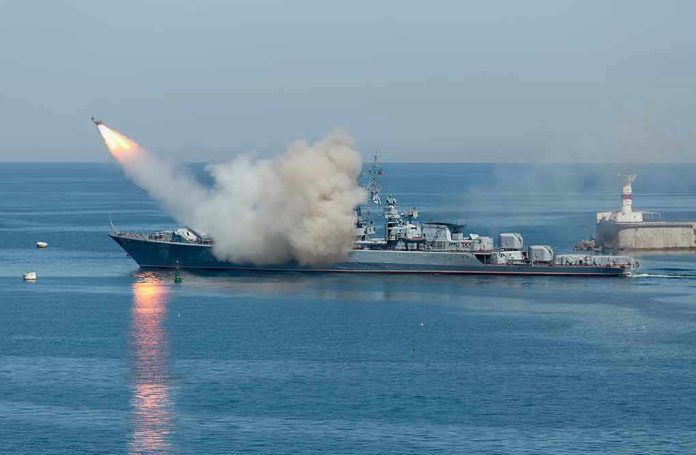
North Korea’s new 5,000-ton destroyer just test-fired nuclear-capable cruise and anti-ship missiles, signaling a dramatic escalation in maritime weaponry that threatens U.S. and South Korean forces—yet independent verification remains impossible, raising questions about whether Americans are being kept in the dark about genuine threats or fed inflated claims by a government eager to justify military spending.
Story Snapshot
- North Korea conducted test launches of two strategic cruise missiles and three anti-ship missiles from its first domestically built 5,000-ton destroyer, the Choe Hyon, with state media claiming “ultra-precision” accuracy and hits on targets in the Yellow Sea.
- Leader Kim Jong Un oversaw the drills and emphasized “unlimited development” of nuclear weapons capabilities, framing the tests as advancing military readiness and deterrence.
- All details come exclusively from North Korean state media (Korean Central News Agency); no independent verification, satellite imagery, or allied intelligence confirmation has been publicly disclosed.
- The destroyer is designed to carry nuclear-capable ballistic and cruise missiles alongside conventional anti-air and anti-ship weapons, though actual warhead integration remains unproven.
- Experts cite North Korea’s history of missile technology proliferation to adversaries like Iran, raising concerns about the credibility and operational maturity of the Choe Hyon’s integrated weapons systems.
North Korea’s Newest Naval Threat
The Choe Hyon represents North Korea’s first domestically constructed 5,000-ton destroyer, equipped with integrated weapons command and control systems designed to detect, track, and coordinate strikes across multiple platforms. [6] State media reported that the vessel successfully validated onboard sensors, fire control software, and combat management systems during the April 2026 tests, with cruise missiles reportedly flying for more than two hours along designated trajectories over the Yellow Sea before striking their targets. [7] The tests marked the third known launch of strategic cruise missiles from the destroyer and included three anti-ship missile firings, all described as hitting their intended marks with precision accuracy.
Unverified Claims Raise Credibility Questions
Every factual detail about the Choe Hyon tests originates from North Korean state media, with no independent confirmation from U.S., South Korean, or allied intelligence agencies. [1][3] While South Korean military officials acknowledged detecting the missile launches, they have not publicly released analysis of flight paths, impact zones, or system performance. The absence of satellite imagery, telemetry data, or third-party observation creates a significant gap: readers cannot distinguish between genuine operational achievement and state propaganda designed to project strength domestically and internationally. This information vacuum mirrors a broader frustration shared across the political spectrum—that government agencies withhold critical intelligence from the public while relying on citizens to accept official narratives without scrutiny.
Nuclear Integration Remains Undemonstrated
North Korean state media asserts that the Choe Hyon is designed to carry nuclear-capable ballistic and cruise missiles, and Kim Jong Un pledged “unlimited and sustained” expansion of the country’s nuclear arsenal following the tests. [9] However, no evidence has emerged confirming actual warhead mating, integration testing, or sea-based nuclear firing capability. The claims rest entirely on KCNA statements without accompanying technical specifications, yield data, or defector testimony confirming nuclear functionality. This distinction matters: a destroyer equipped with conventional cruise and anti-ship missiles poses a regional maritime threat, while a true nuclear-capable platform represents a fundamentally different level of strategic concern—one that would justify substantial shifts in U.S. military posture and allied defense spending.
🚨 North Korea says it will deploy new long-range artillery systems near the South Korean border this year and commission its first modern destroyer, Choe Hyon, in June.
Kim Jong Un also confirmed additional missile and rocket launcher deployments#NorthKorea #sstvi #ArmyMéxico pic.twitter.com/hHITUDXQh7
— Geo Politics Desk (@GeoPoliticsDesk) May 8, 2026
Proliferation History Adds Weight to Threat Assessments
Security experts point to North Korea’s documented record of exporting advanced missile technology to hostile regimes as evidence that the Choe Hyon’s capabilities could eventually reach adversaries worldwide. [3] The country has sold ballistic missile systems to Iran and other nations, demonstrating both technical competence and willingness to spread weapons technology for financial gain. This history suggests that even if current tests remain unverified, the underlying technical foundation—cruise missile design, naval integration, fire control systems—likely reflects genuine progress rather than fabrication. The convergence of state media claims, expert assessments of North Korea’s technical track record, and the geopolitical reality of ongoing U.S.-North Korea tensions creates a credible threat narrative, even without independent confirmation of specific test results.
Timing Raises Strategic Questions
The April 2026 tests occurred amid U.S. naval presence in the region and regional military exercises involving American and South Korean forces. [2] Analysts have interpreted the timing as a “calibrated message” to U.S. forces, signaling North Korea’s willingness to demonstrate advanced capabilities during periods of heightened military activity. This pattern—provocative tests timed to coincide with allied deployments—has repeated throughout North Korea’s nuclear and missile development program, creating a cycle of demonstration, response, and escalation that both Democrats and Republicans have criticized as evidence of failed diplomatic and deterrence strategies across multiple administrations.
Sources:
[3] North Korean leader oversees missile tests from naval destroyer
[6] Photos show North Korea’s Kim Jong Un observing missile tests …
[7] North Korea’s New Destroyer Sets Sail for the First Time, Tests …
[9] North Korean destroyer Choe Hyon – Wikipedia