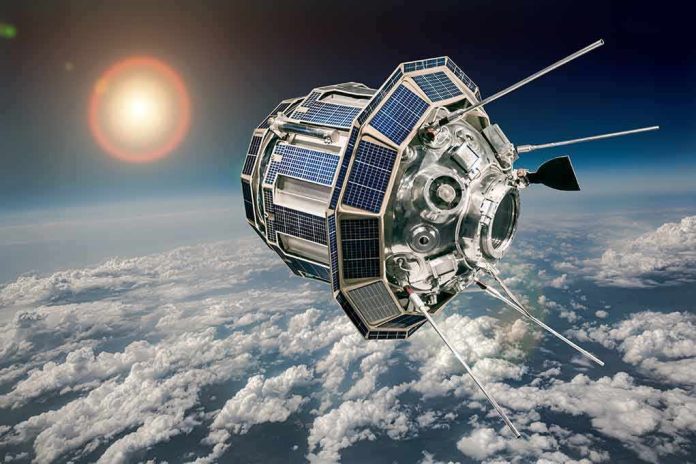
Old satellites do not simply fade into quiet retirement; they carry latent energy that can abruptly reassert itself as shrapnel, turning a long-finished mission into a live hazard for every spacecraft sharing the same orbital lane.
At a Glance
- U.S. Space Forces–Space confirmed a fragmentation event of the retired U.S. satellite USA 32 on 13 September 2026 at about 21:13 UTC in low Earth orbit.
- Analysts judge an internal failure—residual propellant or battery rupture after decades of thermal cycling—as the most likely cause.
- The breakup occurred in a heavily used orbital band, prompting routine conjunction screening and debris monitoring; no immediate threats were identified initially.
- Historically, most space debris originates from on-orbit fragmentations; aged, unpassivated spacecraft are a recurrent source of such events.
What happened to USA 32 and why it matters
U.S. Space Forces–Space (S4S) confirmed that USA 32, catalog object 19460 and a Cold War–era U.S. surveillance satellite launched in 1988, fragmented in low Earth orbit on 13 September 2026 at approximately 21:13 UTC. The Space Force incorporated the new fragments into standard conjunction assessment screenings and reported no immediate threats while analysis continued. The altitude—roughly 775 kilometers, an already crowded regime for Earth-observing platforms and some communications payloads—ensures that any debris generated will be long-lived, persisting for years to decades absent targeted remediation. This is why a single defunct satellite’s failure has system-level implications; debris multiplies encounter probabilities for hundreds of uninvolved spacecraft operating nearby.
While the precise failure mode is not yet publicly specified, the base-rate explanation is straightforward. After nearly four decades in a harsh thermal and radiation environment, internal energy sources that were never fully neutralized—pressurized propellant tanks, batteries with degraded separators, or gas-charged components—can rupture. The result is a sudden release of energy that breaks structures, shears appendages, and seeds a fragment cloud. Analysts tracking USA 32’s case have consistently pointed to this internal-failure pathway as the leading scenario, with collision by a micrometeoroid or small debris piece a secondary possibility.
How spacecraft fragment: mechanism and signatures
Breakups in orbit fall into a few well-understood categories: internal explosions (most often from residual propellants or batteries), high-velocity collisions with debris or micrometeoroids, and deliberate destructive tests. Each leaves characteristic signatures in fragment count, delta-v distribution (the small velocity changes imparted to pieces), and spatial evolution of the cloud. Internal ruptures typically produce modest delta-vs, yielding a cluster that disperses gradually along the parent orbit. Collisions, particularly hypervelocity strikes by debris or micrometeoroids, skew the fragment field and can impart higher-energy tails. Kinetic anti-satellite tests, mercifully rare, generate conspicuously energetic, widely distributed debris fields.
Because USA 32 was long inactive and not maneuvering, an internally driven fragmentation is consistent with experience. NASA’s debris office has documented that the majority of trackable debris in Earth orbit originates from explosions and anomalous fragmentations of spacecraft and rocket bodies after mission end—events that can occur years or decades after operations cease. That is the uncomfortable physics of stored energy in orbit: unless it is actively removed or rendered inert (a process called passivation), it remains available for an unscheduled release.
This is not an outlier: the historical record of on-orbit fragmentations
From the first significant on-orbit breakup in 1961 to the present, fragmentation events have become a structural feature of the space environment—no longer curiosities, but drivers of long-term risk. Root-cause studies and environment reports from NASA and ESA converge on the same big picture: explosions of spacecraft and rocket bodies are the dominant source of cataloged debris, and the tally of confirmed breakups runs into the hundreds. ESA’s latest reporting places confirmed on-orbit fragmentation events in the mid-600s through the mid-2020s, underscoring both frequency and persistence. These are not isolated mishaps; they are the background noise against which all responsible operators must plan.
The Cosmos-1408 anti-satellite test in 2021, for instance, demonstrated how a single deliberate event can jeopardize vast swaths of low Earth orbit for years, generating thousands of fragments that intersect the traffic of crewed and uncrewed missions alike. By contrast, spontaneous explosions like USA 32’s are not geopolitical statements—but their operational consequences are similar for collision avoidance, scheduling, and mission assurance. In aggregate, they shape the evolutionary trajectory of the orbital environment.
NEW: A 38-year-old U.S. spy satellite has unexpectedly broken apart in orbit, scattering debris through one of the busiest regions of low Earth orbit.
USA 32 (declassified briefing doc attached) launched in 1988 on a classified Cold War mission to monitor Soviet radar systems.… pic.twitter.com/S5kB7rVXex
— Outer Space Today (@outerspacetoday) September 28, 2026
USA 32’s design heritage and the aging problem
USA 32 belonged to a lineage of signals-intelligence “ferret” spacecraft whose job during the late Cold War was to locate and characterize Soviet radar emissions. Many of these buses used simple, robust stabilization schemes and carried pressurized systems and electrochemical energy storage consistent with the technology of their era. None were designed with a 38-year idle period in mind at a high, debris-persistent altitude. Thermal cycling—repeated heating in sunlight and cooling in Earth’s shadow—induces material fatigue and gas diffusion; over tens of thousands of orbits, even conservative designs accumulate risk. That is why passivation became a best practice: vent remaining propellant, safing or depleting batteries, and otherwise eliminating stored energy before end of mission. For many older spacecraft, records of passivation steps are fragmentary, and physical certainty is unattainable without forensic debris recovery.
Operational consequences: managing the risk, not the headlines
Once a breakup is detected, the choreography is well-rehearsed. The Space Surveillance Network tracks new objects as they grow bright enough and separate sufficiently for reliable orbit determination. Conjunction assessment—a probabilistic forecast of close approaches—integrates those tracks into screening for active satellites. Operators receive warnings and can plan maneuvers as needed. S4S indicated that USA 32’s fragments were swiftly folded into this process and that no immediate threats were seen in the earliest evaluations. This workflow is the backbone of spaceflight safety in an era when conjunction alerts number in the tens of thousands per year for large constellations.
But process does not eliminate risk; it manages it. Debris in the 700–800 kilometer belt decays slowly, and each fragment becomes a potential progenitor of further collisions—the cascading scenario popularized as the Kessler syndrome. The responsible response, therefore, is not performative alarm but sustained reduction of future sources: rigorous passivation, design for demise (ensuring components ablate on reentry), end-of-life deorbit or graveyard strategies, and, increasingly, active debris removal for the highest-risk derelicts. NASA and ESA guidance codifies these principles; compliance and verification are the hard work ahead.
What the USA 32 breakup tells policymakers and operators
First, legacy risk is durable. The satellites we launched in the 1980s and 1990s are still part of today’s safety equation. Second, the most effective mitigation is upstream: remove or neutralize stored energy before a spacecraft becomes a derelict. Third, altitude selection is policy: placing short-lived missions in long-lived orbits externalizes costs onto future operators. Finally, transparency helps. Rapid, authoritative confirmation—like S4S’s notice with time and identification—anchors analysis in facts and lowers the temperature in a domain too often clouded by speculation.
USA 32’s end was unspectacular in intent yet consequential in effect. That is the nature of the orbital commons we have built: most hazards are not acts of malice but of physics meeting engineering choices made decades earlier. Living with that reality means designing—and regulating—like we intend to use low Earth orbit for generations.
Sources:
insiderpaper.com, gadgetreview.com, livescience.com, gizmodo.com, thedebrief.org, hou.usra.edu, nasa.gov, sdo.esoc.esa.int