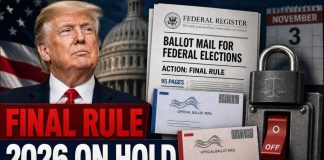
A president saying there are “no limits” to his power in wartime should make every American sit up and pay attention.
Story Snapshot
- Trump told Axios the Iran war taught him there are “no limits” to his power, even as he admitted he “knows” limits exist.[1]
- He called the new 14‑point Iran memorandum “probably unconditional surrender,” while critics say it is a temporary ceasefire with big U.S. concessions.[1][7]
- The Constitution and War Powers Resolution still place legal limits on any president’s ability to wage war or lift sanctions alone.[16][18]
- Media on the left are using Trump’s words to paint him as a dictator, while often glossing over Iran’s role in starting and escalating the conflict.[3][20]
What Trump Actually Said About ‘No Limits’ To His Power
In his first major interview after signing a 14‑point memorandum with Iran, President Donald Trump told The Axios Show that the war had not taught him any lesson about limits on his power.[1][5] Asked directly what the conflict showed him about presidential limits, he replied, “There are no limits… I haven’t learned that lesson yet. I know there are, but there are no limits.”[4][7] Trump framed the entire Iran campaign as proof of American strength, not a warning about overreach.[1][4]
Trump pointed to a U.S. naval blockade in the Strait of Hormuz and claimed that “not one ship” was able to get through while the operation was underway.[2][4] He also said, “We defeated them totally militarily,” arguing that Iran only came to the table because of U.S. pressure and fear of further strikes.[3][6] At the same time, he admitted he ended the bombing to avoid a global oil shock and possible depression, suggesting economic realities did place a check on continued escalation.[2][7]
What The Iran Deal Really Does — And Does Not — Do
The new U.S.–Iran memorandum is a digitally signed 14‑point framework that pauses fighting for 60 days, reopens the Strait of Hormuz, and lays out a path for sanctions relief.[1][3] The text says Washington will “eliminate all forms of sanctions against Iran… on a mutually agreed schedule as part of the final agreement,” giving Tehran a major economic lifeline if talks succeed.[1] During the ceasefire, the United States agrees not to add new sanctions or deploy more forces, while Iran keeps its current nuclear program in place.[1][3]
The deal is not a full peace treaty; it is a temporary arrangement that buys time for more bargaining.[1][2] Key issues, such as long‑term nuclear limits and Iran’s ballistic missile program, are left vague or pushed into follow‑up talks.[3] That is why even critics of Trump’s war argue the memorandum looks more like a tactical pause than the “total defeat” the president describes.[2][20] The agreement clearly shows U.S. leverage from military and economic pressure, but it also shows that Iran is still standing and still negotiating hard.[1][3]
Do Presidents Really Have ‘No Limits’ In Wartime?
The United States Constitution splits war powers between Congress and the president, which means no commander in chief actually has unlimited authority.[18] Article I gives Congress the power to declare war and to fund or cut off military operations, while Article II makes the president commander in chief in carrying out those authorized wars.[18] Legal guides stress that both branches are meant to cooperate, especially when it comes to starting or continuing major conflicts like the Iran war.[18]
After Vietnam, Congress passed the War Powers Resolution to push back on presidents acting alone.[16] That law requires the president to notify Congress within 48 hours of sending forces into hostilities and to end those operations within 60 days, plus up to 30 more for withdrawal, unless lawmakers approve further action.[16] Civil liberties groups argue Trump’s ongoing Iran campaign went beyond defensive action and lacked fresh authorization, calling it unconstitutional and urging Congress to assert its power over war and funding.[13][14]
Why This Matters For Conservatives Who Care About The Constitution
For many on the right, Trump’s confidence feels like a welcome break from the weakness and apology tours of past globalist presidents. But even strong leaders must operate under the Constitution, or the same unchecked powers could someday be used by a left‑wing White House against gun owners, religious groups, or political opponents. Legal scholars warn that decades of court deference and congressional inaction have already weakened real checks on war powers.[17]
On "The Axios Show," Trump says there are "no limits" to his power while discussing Iran. pic.twitter.com/9Nqr6FUoEg
— BROX (@Yamatosenseiii) June 19, 2026
Media outlets hostile to Trump are eager to turn his “no limits” line into proof he is an aspiring dictator, while often ignoring Iran’s aggression, the regime’s support for terror, and the real need to protect American troops and energy supply lines.[2][20] At the same time, they highlight the cost and uncertainty of the war to argue that the United States has not achieved a clear victory and that the memorandum leaves Iran’s nuclear program largely intact.[3][20] For constitutional conservatives, the challenge is to support American strength abroad while insisting that even a president they like must respect clear legal limits at home.
Sources:
[1] YouTube – Trump claims ‘no limits’ on his power amid Iran war remarks
[2] Web – US releases official agreement with Iran. Read the 14-point text | CNN
[3] Web – US lifts naval blockade as Iran’s supreme leader says Trump … – BBC
[4] Web – What the Trump-Iran agreement says about Lebanon, Hormuz and …
[5] Web – Iran and U.S. reach deal, Trump and Pakistani prime minister say, as …
[6] YouTube – US-Iran Deal Details Emerge in 14-Point Memorandum
[7] Web – Read the Full Text of the 14-Point Agreement Between the U.S. and …
[13] Web – Does the War Powers Resolution debate take on a new context in …
[14] Web – Can Congress Stop President Trump’s Illegal War Against Iran?
[16] Web – The President’s War Powers | Friends Committee On National …
[17] Web – War Powers Resolution – Wikipedia
[18] Web – Abandoning the separation of powers in times of war – SCOTUSblog
[20] Web – The Iran-Contra Affair 30 Years Later: A Milestone in Post-Truth …