President Zelensky’s proposal for a demilitarized zone in Ukraine’s eastern heartland challenges Russian territorial ambitions while seeking peace.
Story Overview
- Zelensky proposes a demilitarized and internationally monitored zone in eastern Ukraine.
- The plan includes mutual troop withdrawals and a local referendum.
- This proposal is part of a broader U.S.–Ukraine peace initiative.
- Russia’s response will be crucial to the peace process’s success.
Zelensky’s Proposal for Eastern Ukraine
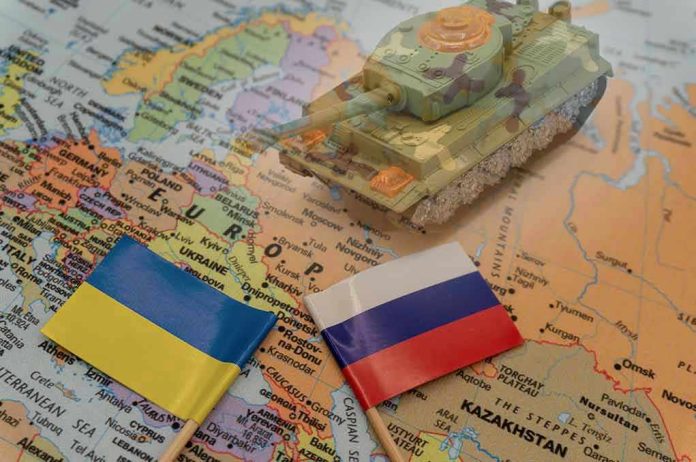
Ukrainian President Volodymyr Zelensky has proposed creating a demilitarized zone in parts of the eastern industrial heartland of Ukraine, contingent on mutual troop withdrawals and a local referendum. This area, broadly known as the Donbas, has been a focal point of conflict since Russia’s intervention in 2014. Zelensky’s proposal is part of a 20-point draft peace plan developed in collaboration with the United States, aimed at achieving a peaceful resolution.
The demilitarized zone would be monitored by international forces and transformed into a free economic zone to attract investment and facilitate reconstruction. The proposal also includes a referendum allowing the local population to determine the area’s final status, thereby preserving Ukrainian sovereignty claims while addressing Russian demands for influence over the region.
Background and Context
The eastern industrial heartland, including Donetsk and Luhansk, has been contested since the onset of Russian-backed separatist movements. The conflict intensified with Russia’s full-scale invasion in February 2022, leading to prolonged fighting in the east and south of Ukraine. The proposed demilitarized zone aims to de-escalate tensions and create a buffer against further military engagements, reducing civilian casualties and fostering a stable environment for economic growth.
The peace talks in Florida between U.S. and Ukrainian officials have focused on securing guarantees that mirror NATO’s Article 5, which would ensure U.S. intervention in case of an attack on Ukraine. This approach seeks to stabilize Eastern Europe without formal NATO membership for Ukraine, addressing security concerns while providing a framework for economic recovery.
Potential Impact and Reactions
The proposal’s acceptance could significantly reduce active fighting and create a formal buffer zone, limiting artillery exchanges and civilian casualties. However, the transition phase could be vulnerable to ceasefire violations, especially if the international monitoring forces are not adequately empowered. The demilitarized zone plus economic incentives might frame Russia as obstructive if it refuses the proposal, thereby enhancing Ukraine’s negotiation leverage.
Long-term, the proposal could lead to a frozen conflict with ambiguous sovereignty, or it might pave the way for either reintegration under Ukraine or formal separation, depending on political evolution and referendum outcomes. The success of the proposal could reshape Europe’s security order, anchoring Ukraine under a U.S. defense umbrella and potentially serving as a model for similar conflicts elsewhere.