
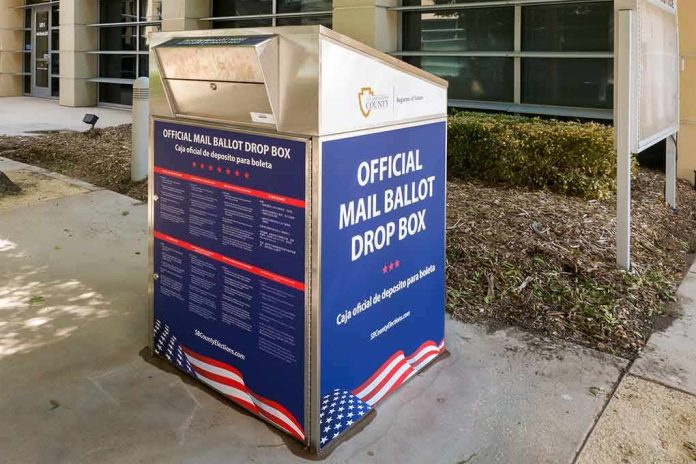
When federal election fights drift from high principle to postal logistics, pay attention; the line between “mail operations” and “voter access” is where the law, the Constitution, and the mechanics of ballot delivery collide—and where courts have repeatedly drawn a hard stop on executive attempts to rewrite election rules through the U.S. Postal Service.
At a Glance
- Federal courts have repeatedly enjoined attempts to use USPS rulemaking to control who receives and returns mail ballots, finding a lack of statutory authority and constitutional defects.
- The central legal fault line is authority: the Elections Clause assigns the structure of federal elections to states and Congress, not the president, DHS, or USPS.
- USPS’s final ballot-mail rule mirrored the executive order’s design—state “participation lists,” mandatory barcodes, and non-acceptance of noncompliant outbound ballots—but the agency conceded it could not implement for 2026 without relief from injunctions.
- Supporters frame the package as chain-of-custody modernization; challengers show how rigid “standards” function as gatekeeping that risks eligible voters’ ballots never mailing or never counting.
What the courts actually blocked—and why
Two linked efforts drove the controversy: a presidential executive order directing the Department of Homeland Security to compile and transmit citizenship-related lists to states and pushing USPS to set “uniform standards” for ballot mail; and a USPS rulemaking that would operationalize those directives by requiring states to submit mail-ballot participation lists and adopt specified design features, including unique barcodes on outbound and return envelopes. In June 2026, U.S. District Judge Indira Talwani blocked implementation of the order’s core mail-voting restrictions, holding that the president lacked authority to direct DHS to compile voter-eligibility lists and that USPS had no statutory authorization to adopt binding regulations governing mail-in voting. Days before the midterm cycle tightened further, she issued a temporary restraining order halting “core parts” of the USPS rule—including provisions that would have required USPS to refuse noncompliant outbound federal ballot mail—for 14 days pending a fuller preliminary injunction decision.
These were not exotic doctrines. They reflect a basic allocation of power: states set the “Times, Places and Manner” of federal elections subject to alteration by Congress, not by executive edict. Courts have therefore asked two threshold questions. First, does any federal statute give DHS or USPS the authority to control voter eligibility or dictate ballot-mail acceptance criteria? Second, even if the executive branch could encourage operational best practices, can it condition the transmission of ballots on federalized eligibility lists or design standards absent congressional authorization? In the injunction rounds, the answers were no and no—and that was decisive, even before courts reached deeper merits about burdens on voters.
What the USPS rule would have done in practice
The finalized USPS rule, published despite ongoing litigation, was explicit: states would need to provide lists of voters authorized to receive mailed ballots and embed unique barcodes on both outbound ballot packets and return envelopes. USPS said mailings addressed to individuals not on the state list or that failed specified design standards would not be accepted for delivery. The agency also stated it would refrain from implementing the rule for the 2026 election unless the government obtained relief from the injunctions—an unusual public acknowledgment of legal jeopardy inside an otherwise assertive rulemaking.
From an operational perspective, the design reads like a supply-chain upgrade—traceable pieces, standardized packaging, digital handshakes between state systems and USPS portals. But when the product is a ballot, “non-acceptance” is not a shipping delay; it is a veto on whether the ballot ever reaches the voter. That is why courts and election administrators scrutinize who decides compliance and what happens to edge cases—late list updates, typo-driven mismatches, or counties with legacy print vendors that cannot retool envelopes on litigation-compressed timelines. Those details determine whether eligible voters receive ballots at all, not just whether tracking is crisp.
The administration’s integrity rationale—and its limits in law
Defenders of the order and rule framed the package as integrity-forward: unique identifiers to cut fraud risk, standardized handling to secure ballot chains of custody, and DHS-compiled lists to ensure only citizens receive and cast ballots. That logic lands with many voters who expect modern logistics around anything as consequential as a ballot. But courts do not evaluate federal election regulations by intuition; they ask who holds the pen. The Elections Clause gives state legislatures primacy over election machinery, with Congress empowered to alter by statute. Agencies cannot bootstrap that power from general postal authorities into election gatekeeping—especially when the rule crosses from moving mail to deciding which ballots may move at all.
This is why similar efforts have met resistance even when packaged as operational neutrality. A prior round of litigation cataloged USPS’s 2021 settlement obligations to prioritize election mail; the government’s claim that USPS could now police ballot eligibility and design as a precondition of acceptance ran headlong into that record and the bedrock separation between mail carriage and election administration.
Injunction churn is not merits vindication
The procedural history is messy by nature: temporary restraining orders, preliminary injunctions, emergency stays, and a Supreme Court interlude addressing the challengers’ standing rather than the legality of the framework itself. That churn can confuse the public into reading a lifted injunction as policy endorsement; it is not. When the Supreme Court removes an injunction on standing grounds, it says nothing about whether the policy is lawful—only whether the particular plaintiffs made the threshold showing to sue at that moment. Here, the government celebrated interim relief while USPS simultaneously signaled it would not implement the rule for 2026 without further judicial permission—hardly a posture of unambiguous legal strength.
The most concrete judicial statements cut the other way: categorical findings that the president lacked authority to order DHS to create voter-eligibility lists for state use and that USPS lacks statutory power to adopt binding mail-voting rules. Those holdings go to the architecture of federal power, not to ephemeral timing disputes, and they are why subsequent district-court orders again froze the most invasive parts of the USPS rule while fuller merits arguments proceeded.
Where the real stakes lie: mechanism, not slogans
Strip away the slogans and look at the mechanism. Requiring state “participation lists” as a condition of acceptance puts USPS in the position of auditing voter eligibility by reference to a federalized dataset it does not control. Mandating envelope barcodes is not controversial on its own—many jurisdictions already use Intelligent Mail barcodes—but coupling design compliance to delivery acceptance creates a single point of failure: a printer spec missed, a barcode symbology off by one version, and a county’s entire outbound batch can be sidelined. In commercial mail, that is a service error. In elections, it is mass disenfranchisement risk—without any legislative judgment by Congress authorizing that trade-off.
There is a clean pathway if Washington truly wants national ballot-mail standards: congressional legislation that defines the standards, provides funding for state and local implementation, and cabins USPS’s role to what it does best—moving the mail quickly and predictably under clear statutory guardrails. Courts have been signaling exactly that for years. Until Congress acts, the constitutional settlement holds: states run elections; the federal executive does not rewrite them by postal rule.
A federal judge in Boston has extended an injunction preventing the Trump administration from enforcing new nationwide Postal Service requirements for mail ballots. https://t.co/FOv8uM6rAt
— yourNEWS.com (@yourNEWS_com) September 5, 2026
What to watch next
Three questions will decide the policy’s future. First, does Congress choose to legislate uniform ballot-mail standards, which would moot much of the authority fight while forcing a transparent debate over design, tracking, and funding? Second, do challengers obtain final merits rulings—beyond preliminary relief—cementing that USPS cannot condition ballot transmission on federal lists or design sign-offs? Third, can states and USPS collaborate on voluntary best practices—barcodes, intelligent tracking, envelope visibility—without conflating operational upgrades with eligibility gatekeeping? The litigation to date points to a durable answer: modernization within clear statutory bounds is welcome; federalized control over who gets a ballot is not.
Sources:
aclu.org, lwv.org, axios.com, aclum.org, congress.gov, democracydocket.com