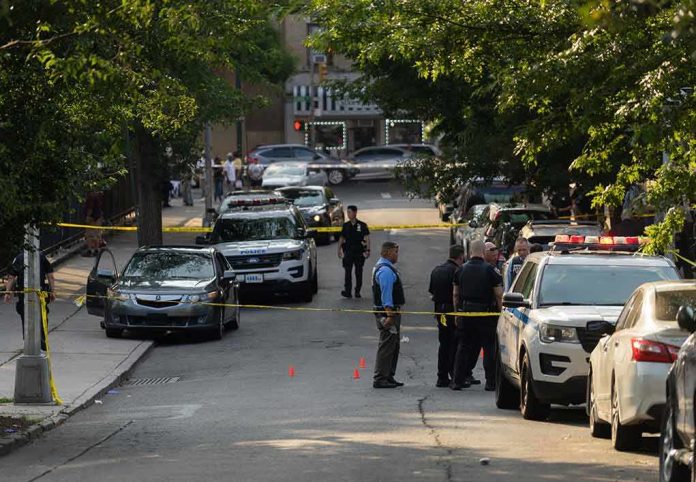
When gunfire breaks out at a high-school football game, the story is not just the chaos on the bleachers; it is how investigators stitch together identification from video, vehicles, and phones—and how courts apply routine pretrial rules even when public emotion runs hot.
At a Glance
- Prosecutors charged an 18-year-old with two counts of second-degree assault with a dangerous weapon and one count of second-degree riot after two teens were shot outside Eden Prairie High School’s homecoming game.
- Investigators say surveillance video, a specific Hyundai Sonata, cellphone-location data, and seized clothing collectively tie the defendant to the shooting.
- Both victims—ages 17 and 18—survived with leg and foot wounds; reporting describes a fistfight just before the gunfire.
- Hennepin County jail records show the defendant posted a $100,000 bond (or $10,000 cash option) and was released pending court.
What prosecutors say happened at the homecoming game
Charging documents, as summarized by multiple outlets, describe a confrontation that moved from a stadium-area fight to gunfire in the parking lot. Surveillance video reportedly shows the driver of a Hyundai Sonata pulling in while a group scuffled; the driver exits and fires, striking a 17-year-old in the leg and an 18-year-old in the foot. Both survived. Police later identified the Sonata as registered to the defendant’s brother and, from there, built a timeline that places the charged 18-year-old with the car before, during, and after the shooting, aided by cellphone-location data and subsequent investigative steps.
The Hennepin County Attorney’s Office filed three felony counts: two for second-degree assault with a dangerous weapon—Minnesota’s aggravated assault statute applied when a firearm is involved—and one for second-degree riot while armed with a dangerous weapon, a charge that attaches when a group-related altercation escalates with a weapon present. These are serious violent felonies with sentencing exposure that depends on criminal-history score and the guidelines grid; they sit well beyond misdemeanor fighting or disorderly conduct.
The investigative spine: video, a specific vehicle, and phones
Modern violent-crime cases often turn on triangulation: corroborating identity by linking a person to a vehicle, a device, and distinctive apparel. Here, the complaint summaries attribute the initial lead to stadium-area video capturing the shooter’s movements and clothing; the car is not a generic sedan but a Hyundai Sonata that investigators could trace to a particular registrant. The Sonata connection is not dispositive on its own—the car was reportedly registered to a brother—but it narrows the field of plausible shooters to people with access. Investigators then layered cellphone-location records to show the charged teen moving with the vehicle across the critical window, bolstering the theory that the driver and shooter are the same person.
Police also executed a residential search and seized clothing said to match items visible in the surveillance footage—detail that moves the case beyond pure digital inference. While early reporting does not mention a recovered firearm or ballistics match, the clothing seizure functions as physical corroboration of the video-based identification. In practice, a prosecutor does not need a recovered weapon to sustain probable cause when video, access to the getaway car, and contemporaneous device movements cohere into a single narrative.
What is known, what is not, and why that matters for court
The public record establishes the core facts with consistency across outlets: a fight outside a homecoming game, two non-student victims with survivable wounds, and a flight from the scene followed by a targeted arrest. The complaint summaries do not assert a motive, nor do they present an eyewitness who personally names the defendant at close range; that is not unusual at this stage, when prosecutors rely on probable-cause filings rather than a full evidentiary proffer. Likewise, the lack of a publicly described firearm recovery is a gap in the narrative, not a fatal flaw; many assault-with-a-weapon prosecutions proceed on circumstantial mosaics that juries find compelling when the pieces fit.
Bond provokes the strongest public reactions in cases like this, especially when video of a stadium evacuation circulates. Minnesota’s pretrial system, however, is designed to calibrate risk and ensure appearance, not to pre-punish. Hennepin County jail records show the court set a $100,000 bond (with a $10,000 cash option) and the defendant posted it, securing release under conditions the court deemed adequate for public safety and court compliance. That outcome is not aberrational; it reflects a statutory framework that presumes release under conditions unless the state shows otherwise, and it preserves the distinction between allegation and adjudication.
The setting: youth-sports gun violence is rare but not isolated
High-school football is one of the most visible communal gatherings in American life; when violence intrudes, it commands attention out of proportion to incidence. Education Week’s tracker, which counts only events where someone other than the shooter is struck, recorded 43 football-game shootings from 2018 onward—a reminder that while the denominator is vast and the rate low, the phenomenon recurs often enough to warrant policy planning on supervision, egress routes, and post-incident reunification.
Local officials and community leaders responding to the Eden Prairie shooting situated it within a broader effort to address youth group violence while drawing a careful line: acknowledging specific patterns without stigmatizing entire communities. That balance—naming a cluster of cases to coordinate prevention, but resisting the slide into demographic blame—protects both public safety and civic cohesion when fear tempts easy generalizations.
Earlier today, I called on Hennepin County Attorney Mary Moriarty to answer critical questions about the prosecution's recommendations in the Eden Prairie High School shooting case.
Following today’s court appearance for Adam Abdihakeem Adam—charged in connection with the Oct. 2…— Wikstrom For Congress (@Wikstrom2026) October 12, 2026
How this case will likely move from here
From a criminal-process perspective, expect several steps. First, discovery will flesh out the digital trail: warrant returns for cellphone location data, chain-of-custody for surveillance footage, and search-warrant inventories that document seized clothing. Second, lab work may clarify ballistics even if no gun is recovered, via casing pattern analysis or projectile characteristics. Third, defense counsel will test identification through suppression motions (challenging warrants or data scope) and plausibility (access to the registered vehicle, clothing commonality). This is the ordinary adversarial sorting that converts an investigative mosaic into admissible proof—or trims it to what can be fairly presented at trial.
The takeaway: evidence-led accountability without spectacle
The Eden Prairie case shows the modern mechanics of accountability: cameras, cars, and phones converge to identify a shooter; courts apply standard pretrial rules despite public anger; and community leaders aim to address violence without widening the circle of blame. The facts that matter for adjudication are already in focus—video of the act, a traceable vehicle, device data, and corroborating clothing—while the open questions, including motive and any forensic firearm link, will be resolved, if at all, in the ordinary course. That is how a serious prosecution should proceed: not by rhetoric, but by evidence.
Sources:
foxnews.com, cbsnews.com, fox9.com, kstp.com, alphanews.org, patch.com, noticias.foxnews.com