

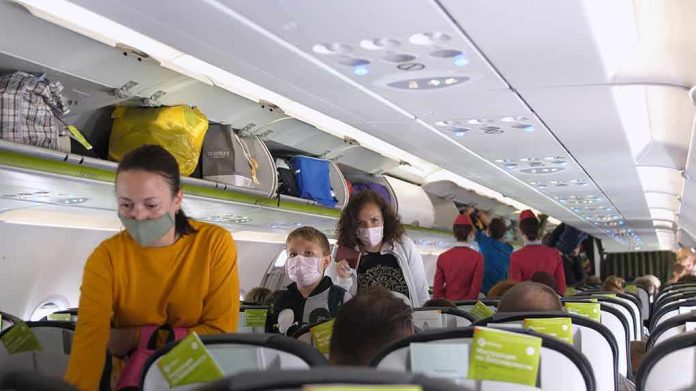
The debate about holiday masking only sounds binary; in reality, it’s a question of matching the right tool to the right risk, for the right person, in the right setting.
At a Glance
- Targeted masking is a reasonable, expert-backed option for higher-risk people in crowded indoor travel settings; it is not a mandate-everywhere doctrine.
- N95-class respirators have a clear technical edge over looser face coverings, but protection depends on fit and consistent use.
- Airplanes are only part of the exposure story; lines, jet bridges, and terminals often present denser, less controlled air than the cabin itself.
- Evidence for universal community masking remains mixed; focused use by vulnerable travelers during peak holiday congestion is the defensible middle ground.
What experts actually recommend: targeted, situational masking
Holiday travel is a collision of biology and behavior: more people, in closer quarters, with circulating respiratory pathogens. Public‑health and infectious‑disease specialists have converged on a pragmatic message in this context: masking is an available extra layer for specific situations and specific people, not a standing rule for everyone. Advice around recent Thanksgiving travel emphasized basic hygiene and encouraged masks in crowded indoor spaces, especially for those at elevated risk or with reduced vaccine protection. The emphasis was not on universal masking but on empowering travelers who are older, immunocompromised, pregnant, or traveling with infants to add a meaningful layer of protection when congestion spikes and ventilation varies across settings.
That stance matters because it resolves a false choice. You need not accept a return to mandates to find value in voluntary, well‑chosen precautions when crowds and exposures intensify. It also aligns with institutional reviews that do not see strong support for blanket community masking, yet leave room for targeted use in higher‑risk, transient scenarios common in holiday travel.
Mechanism and materials: why N95s are different
Not all masks are created equal. The most protective consumer-available option is a National Institute for Occupational Safety and Health (NIOSH)–approved N95 respirator, engineered to filter at least 95 percent of airborne test particles under standardized conditions. That specification reflects both the filter media and the face seal; the latter is what separates a respirator from a loose face covering. The practical implication is straightforward: if you are relying on a mask to reduce inhalation of suspended particles in a crowded concourse or jet bridge, a properly worn N95 (or equivalent like a KF94/FFP2 standard) delivers markedly more consistent performance than cloth masks or loosely worn surgical masks. The caveat is embedded in the promise—fit and wear-time drive real-world benefit. On-and-off use for eating and drinking, jaw movement that breaks the seal, or substituting a poorly fitting product will erode the advantage.
This fit‑dependence explains why public messaging that simply says “wear a mask” often disappoints: the evidence base—and the lived experience of travelers—hinges on the specifics of the device and behavior, not the category label. Experts recommending masks for higher-risk travelers are implicitly recommending high‑filtration, well‑fitting respirators, worn consistently when exposure risk peaks.
Where exposure happens: aircraft versus the rest of the journey
Aircraft cabins have unusually high air‑change rates and HEPA filtration; when everyone is seated and systems are operating, that environment can dilute aerosols faster than many indoor spaces. But your trip is not confined to the seat. Security lines, crowded gates, boarding queues, and especially jet bridges routinely pack travelers into stagnant zones where ventilation is less reliable. That is where a well‑fitted respirator earns its keep. The research record reflects this nuance. Some investigations have associated nonuse or partial use of masks with higher infection odds on specific flights, while a broader comparative analysis found no statistically significant difference in SARS‑CoV‑2 attack rates between masked and unmasked flights overall—a reminder that route, timing, ventilation, index cases, and compliance all modulate risk.
For influenza and other droplet‑ and aerosol‑spread viruses, findings are similarly heterogeneous across events and methods, with systematic reviews emphasizing combinations of measures—vaccination, hand hygiene, symptom screening, and masking—rather than any single silver bullet during travel. Combined strategies consistently outperform any one intervention acting alone, particularly when prevalence is high and journeys include multiple crowded waypoints.
What the evidence supports—and what it doesn’t
Three claims are defensible on current evidence. First, a correctly worn N95-class respirator reduces inhalation of airborne particles and can help an individual traveler lower their exposure during peaks of crowding. That is an engineering property backed by certification standards and consistent with event‑level investigations that show higher risk when masks are unused or inconsistently used. Second, the benefit is greatest for people with more to lose biologically—older adults, the immunocompromised, pregnant travelers, and infants—and for those who must remain around sick individuals despite symptoms. Third, universal, everyday masking for the general healthy public is not well supported outside surge or outbreak conditions; a government evidence review reached that cautious conclusion, even as it left room for vulnerable individuals to use masks in transient high‑risk situations—exactly the travel windows we are discussing.
What the evidence does not do is guarantee population‑level effects from generic “masking” in the absence of details on type, fit, adherence, and context. Nor does it resolve disease‑specific reductions for COVID‑19 versus influenza versus RSV or measles in the precise mix of airport concourses and holiday gatherings. Those gaps argue for humility in messaging: offer targeted, technically sound options to those who benefit most, and avoid sweeping edicts or dismissals that outrun the data.
Practical guidance for travelers who want the extra layer
If you are in a higher‑risk group—or traveling with someone who is—and you want to reduce your odds of picking up a respiratory infection during peak holiday flow, three practices make sense. Carry a NIOSH‑approved N95 (or equivalent) that fits your face; test the seal by checking for inward collapse on a sharp inhale. Wear it during the highest‑density portions of your journey: security lines, crowded gates, boarding and deplaning, jet bridges, and packed shuttles. Keep it on continuously in those windows rather than donning and doffing repeatedly. Pair the respirator with the basics that compound benefit: stay current on indicated vaccines, wash or sanitize hands after high‑touch surfaces, and avoid close contact if you or your companions develop symptoms. This layered, situational approach is what experts are actually endorsing—not a return to universal masking, but a sober use of a proven tool when it adds the most value.
If you are healthy and not in a higher‑risk category, the decision is discretionary. Many will opt out; some will opt in during the most crowded segments. The case for voluntary, respectful coexistence is stronger than the case for stigma in either direction.
The bottom line for the next holiday cycle
Holiday travel concentrates exposure. A well‑fitted N95 offers meaningful individual protection during the most crowded, least ventilated legs of the journey, particularly for people at higher risk of severe disease. Evidence for broad, universal masking in the community remains mixed, and a reasonable, durable middle ground has emerged: use the tool when the risk and your personal stakes justify it; don’t confuse that targeted advice with a call for mandates. This framing will remain relevant next season because the underlying variables—pathogen mix, congestion, ventilation, fit, and adherence—will still govern what “works.”
Sources:
facebook.com, nbcbayarea.com, bostonglobe.com, bnd.com, theatlantic.com, commonwealmagazine.org, edition.cnn.com, vermontdailychronicle.com