A recurring category error in American political rhetoric is treating Selective Service registration as if it were conscription itself — and that error, not any documented plan to send civilians to war, is the actual story behind Whoopi Goldberg’s April 2026 warning on The View.
Key Points
- Goldberg told The View audience that the Trump administration was “planning on a draft” tied to Iran tensions, repeating the claim twice on air.
- The real policy change is automatic Selective Service registration for men aged 18–25, enacted in the FY2026 National Defense Authorization Act, with rollout expected December 2026.
- Registration and induction are legally and historically distinct: the U.S. has not conducted an actual draft since 1973, even though registration was reinstated in 1980.
- Goldberg’s own co-host, Alyssa Farah Griffin, corrected her on air, explaining the policy concerned automatic enrollment, not conscription.
- No Pentagon document, congressional authorization, or named official supports the claim that an Iran-related draft is imminent.
What Goldberg Actually Said on Air
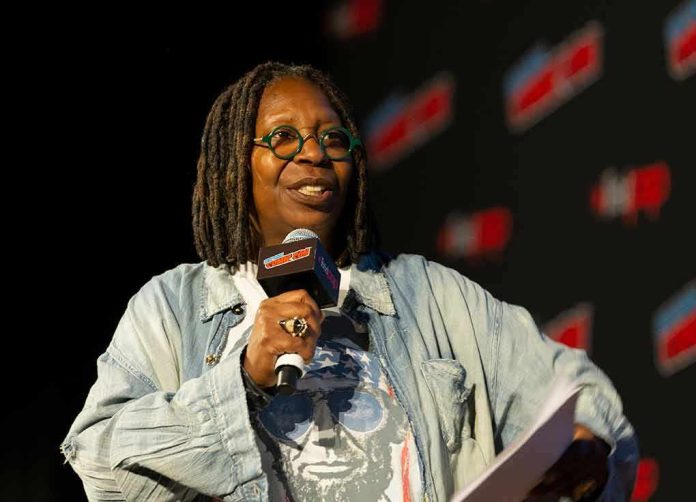
On the April 20, 2026 broadcast, Goldberg told viewers, “That’s why they’re planning on a draft. They’re planning on a draft,” and moments later sharpened the warning: “It’s a draft… Because if you are 18 to 25, they’re looking at you!” The remarks were made in the context of a discussion about Trump’s Iran policy and military posture, and the exchange is preserved in contemporaneous broadcast recordings and transcripts. There is no dispute that Goldberg made these statements; the recording exists, the words are hers, and the segment aired to a national daytime audience that regularly numbers in the millions.
What is disputed — and disputed specifically, not vaguely — is whether the underlying premise holds up. That distinction matters, because the strength of a claim like this rests entirely on whether the policy she described actually does what she said it does.
The Policy Goldberg Was Describing: Automatic Registration, Not Conscription
The real administrative change Goldberg referenced is genuine. President Trump signed the FY2026 National Defense Authorization Act in December 2025, and it includes a provision requiring automatic Selective Service registration for eligible males aged 18 to 25, pulled from federal data sources rather than requiring individuals to register themselves. Implementation is expected by December 2026. This is a meaningful bureaucratic shift — it closes gaps in a registration system that has long relied on voluntary compliance — but it is not an order compelling anyone into uniform. Registration identifies who would be eligible if Congress and the President ever reinstated conscription; it does not, by itself, induct a single person.
That distinction is not a semantic nicety. It is the entire legal and historical architecture of the Selective Service System. Congress allowed the Vietnam-era draft authorization to lapse in 1973, moving the country to an all-volunteer force. Registration was reinstated by President Carter in 1980 amid Cold War tensions, but no draft followed it — registration has functioned as a standby mechanism for nearly half a century without being activated. Treating automatic registration as equivalent to an actual draft erases a line that has held, without exception, since the all-volunteer force began.
The Pushback — Including From Her Own Table
The most consequential rebuttal to Goldberg’s claim did not come from a partisan outlet; it came from her co-host. Alyssa Farah Griffin, appearing on the same panel, corrected the record in real time, explaining that the administration was changing registration procedures so eligible men would be enrolled automatically rather than required to opt in — a clarification the Washington Times highlighted as a direct, on-air contradiction. That is a named, contemporaneous, documented correction, not an anonymous objection, and it carries more evidentiary weight than any amount of outside commentary.
Outside critics piled on with less restraint. The Gateway Pundit labeled the claim “misinformation” and stated flatly that “there is no draft”. Commentary from the Rubin Report went further, arguing that the premise itself was dated: with warfare increasingly dominated by drones, robotics, and AI-assisted systems, the strategic case for mass conscription has weakened considerably, undercutting the scenario Goldberg sketched for viewers. None of these critics identified a hidden Pentagon plan or classified assessment to rebut — because the available record does not show that Goldberg or anyone else produced one. The weight of the evidence here is lopsided: a real policy exists, it has a name and a statute, and it does not do what Goldberg said it does.
The Unverified Claim: Did She Tell Service Members How to Vote?
The headline framing — that Goldberg explicitly urged military members to vote against Trump — is the weakest-supported element of the entire episode. The surfaced transcripts and recordings document her draft warning clearly, but they do not contain a verbatim instruction directing service members or military families to cast a particular ballot. That does not mean such a statement was never made; it means the available excerpts, drawn from edited clips and partial transcripts rather than the full unedited segment, do not substantiate it as cleanly as the draft claim itself. Readers should treat the voting-instruction framing as an inference from her broader remarks rather than a confirmed quotation until the complete broadcast record settles the question.
Why This Pattern Keeps Recurring
Claims that a government is quietly preparing a draft surface reliably whenever military escalation enters the news cycle, regardless of which party holds the White House. Scholarship on public attitudes toward conscription finds that draft eligibility measurably reduces support for the policy in peacetime, which helps explain why warnings about an impending draft land with such force among parents of young adults — the fear taps a demographic with direct personal stakes. But base rates matter: in over fifty years of an all-volunteer force, registration changes have repeatedly been floated, debated, and occasionally expanded, and none has preceded an actual induction order. The honest reading of this episode is that Goldberg amplified a legitimate anxiety about Iran policy using a mechanism — automatic registration — that genuinely changed, while overstating what that mechanism actually authorizes.
Sources:
thegatewaypundit.com, washingtontimes.com, mediaite.com, delawareonline.com, grabien.com, news-journalonline.com, detroitnews.com, headlinereporter.com