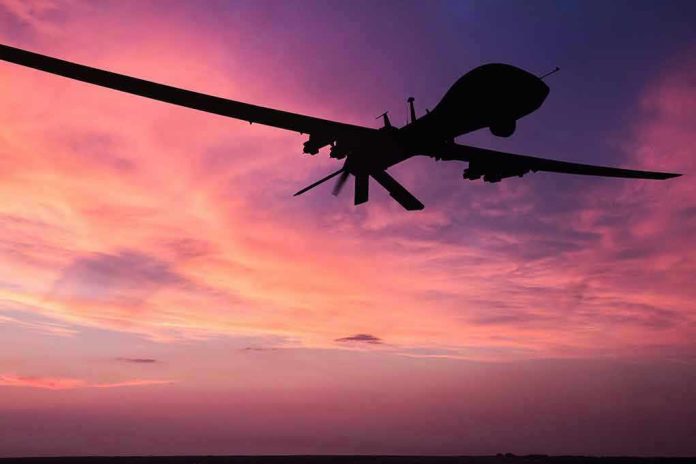
U.S. Navy accelerates unmanned vessel deployments to counter China threats, strengthening American naval dominance under President Trump’s defense priorities.
Story Highlights
- Navy forms three USV divisions in San Diego next week, shifting prototypes Seahawk and Sea Hunter to operational fleet control.
- Seahawk integrates into a carrier strike group next month, enhancing surveillance and anti-submarine warfare capabilities.
- Small USV inventory surges from 4 to nearly 400 in 2025, with $3.7 billion FY2026 investment in surface force unmanned systems.
- Projections aim for 45% unmanned surface force by 2045, bolstering distributed lethality against adversaries.
Navy Announces Rapid USV Integration
Capt. Garrett Miller, commodore of Surface Development Group One, announced at the Surface Navy Association 38th National Symposium on January 15, 2026, the formation of three unmanned surface vessel divisions next week in San Diego. Medium USVs Seahawk and Sea Hunter transition from experimental roles in 2022-2023 fleet exercises to full fleet control this year. Seahawk deploys with a carrier strike group starting next month. This move operationalizes USVs for surveillance, anti-submarine warfare, and reconnaissance amid great power competition. Miller emphasized a mindset shift to treat USVs as warfighting assets, not prototypes. Affordable unmanned systems expand naval reach without risking American sailors, aligning with conservative priorities for strong defense and fiscal responsibility.
Inventory Explosion and Budget Commitment
The Navy grew its small USV inventory from four to nearly 400 in 2025, establishing a dedicated USV warfare officer career path. Rear Adm. Christopher Alexander projected small USVs reaching about 500 and medium USVs to 11 by end-2026. FY2026 budget allocates roughly $7 billion total for unmanned systems, with $3.7 billion to the surface force. This investment supports Surface Force Vision 2045 for hybrid manned-unmanned fleets, including USV squadrons in every fleet. Such growth counters Chinese naval expansion through distributed lethality and persistent operations, protecting U.S. interests without the overspending of past administrations.
Modular Attack Surface Craft Program Advances
The Modular Attack Surface Craft program, evolving from Large and Medium USV efforts, solicits industry input since July 2025 for containerized weapons and sensors. MASCs enable pier-launched operations alongside crewed ships for distributed maritime operations. Program Management Station 406 handles prototyping after NOMARS transition. Industry partners like Saildrone and Lockheed Martin plan JAGM missile live-fire on Surveyor by summer 2026, with Mk 70 VLS on larger hulls. Ultra Maritime supplies NGSSR radars for autonomous navigation in contested areas. This commercial-defense fusion delivers rapid, cost-effective capabilities, embodying American innovation over globalist dependencies.
Hybrid operations integrate USVs with carrier strike groups and surface action groups, providing enhanced intelligence, surveillance, reconnaissance, logistics, and targeting. Short-term gains include risk reduction through prototyping; long-term, a “Naval Hedge Force” ensures magazine depth and stand-off strikes. Navy personnel benefit from new career paths while fleets gain capacity. Congress oversees via CRS reports, endorsing MASC for adjunct roles despite autonomy challenges. This strategic pivot fortifies U.S. maritime superiority, reassuring patriots who demand readiness against threats like China.
Strategic Implications for National Security
USV deployments respond to contested environments requiring endurance, affordability, and lethality. Containerized payloads enable kinetic effects from unmanned platforms. Expert commentary from Miller and Alexander highlights the incredible pace of technological change. No major dissent exists; focus remains on maturation risks like propulsion. Under President Trump, this initiative rejects weak prior policies, prioritizing sailor safety and deterrence. It upholds constitutional duties to provide for the common defense, a victory for limited government that leverages private sector ingenuity.
Sources:
Saildrone, Lockheed to place missile launchers on naval drones
US Navy to deploy unmanned systems with surface forces this year
Navy drones surface fleet unmanned systems SNA
CRS Report on Navy Force Structure and Shipbuilding Plans
Saildrone-Lockheed Martin to arm USVs for hybrid Navy fleet
Ultra Maritime Surface Navy 2026
SWOBOSS delivers status of the force at the 2026 Surface Navy Association
CNO Caudle teases new Naval Hedge Force ahead of warfighting instructions