

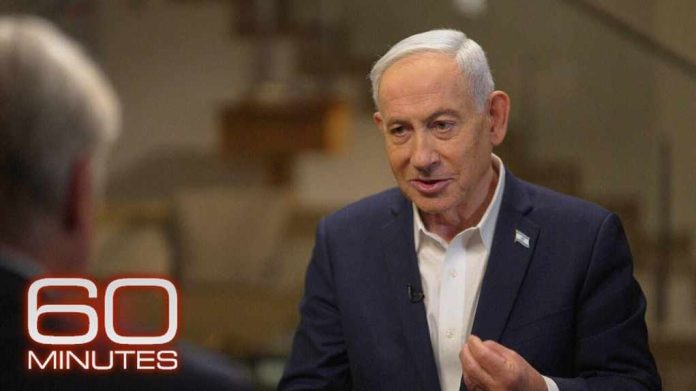
Israeli Prime Minister Benjamin Netanyahu announced plans to eliminate U.S. military aid to Israel within a decade, signaling a dramatic shift in one of the world’s most consequential bilateral relationships and raising urgent questions about whether Washington’s $3.8 billion annual commitment will survive the coming years.
Story Snapshot
- Netanyahu declared on 60 Minutes that Israel will “draw down to zero” American military support over the next ten years, starting immediately.
- The $3.8 billion annual military aid package, negotiated in 2016, expires in 2028 and will not be fully renewed under Netanyahu’s plan.
- Israel is allocating an additional 35 billion New Israeli Shekels annually to domestic munitions production and military self-sufficiency.
- Conservative U.S. allies, including Senator Lindsey Graham, have welcomed the proposal and pledged to accelerate the timeline.
- The plan lacks detailed public accounting of how Israel will replace advanced U.S. systems like F-35 fighter jets and Iron Dome components.
Netanyahu’s Direct Call for Independence
Israeli Prime Minister Benjamin Netanyahu told 60 Minutes in a May 2026 interview that Israel must “wean” itself from American military support over the next decade. When asked whether he meant reducing aid to zero, Netanyahu confirmed: “Yes, to zero.” [1][3] He framed the shift as essential for Israeli sovereignty, stating “it’s time that we’ve come of age” and developed “incredible capacities.” Netanyahu added that Israel deeply appreciates past American assistance but must pursue maximum independence to avoid future constraints on military decision-making. [3] The statement marks the first time Netanyahu has publicly committed to a zero-aid target with a specific timeline.
The Expiring Aid Package and Political Opportunity
The current military assistance arrangement, formalized in 2016, provides Israel approximately $3.8 billion annually in subsidies for purchasing American-made weapons and military systems. [6] This ten-year agreement takes effect in 2018 and expires in 2028, creating a natural renegotiation window. Netanyahu has signaled he will not seek full renewal, effectively allowing the aid to phase out rather than requesting its continuation. [6] The timing aligns with Trump’s second term and a Republican-controlled Congress, both historically supportive of Israel but increasingly focused on “America First” priorities that question overseas spending.
Domestic Defense Spending and Self-Reliance Strategy
Israel’s government has publicized a plan to add approximately 35 billion New Israeli Shekels annually to its defense budget, with explicit focus on increasing domestic capacity to produce munitions and advanced military technologies. [5] Netanyahu has claimed that past U.S. restrictions on aid deliveries—which he attributed to the Biden administration—created ammunition shortages during military operations in Gaza, forcing Israel to pursue accelerated self-production. [2] Under Israel’s 2025 defense budget, the Defense Ministry alone received 110 billion New Israeli Shekels ($29 billion), part of a total defense budget of 136 billion New Israeli Shekels ($36.9 billion). [6]
Conservative U.S. Allies Embrace Acceleration
U.S. Senator Lindsey Graham, chairman of the Senate Appropriations Subcommittee overseeing military aid, welcomed Netanyahu’s commitment and vowed to “dramatically expedite the timetable” for phasing out American support. [6] Graham argued that terminating aid to Israel would free billions of dollars to be “plowed back into the U.S. military,” aligning Netanyahu’s proposal with Trump administration priorities to redirect spending toward American defense needs. [6] This bipartisan Republican support suggests the political pathway for ending aid may encounter fewer obstacles than historical precedent would suggest.
No, the US has not made any 90-year deal with Israel recently.
Current military aid is set by a 10-year Memorandum of Understanding (2019-2028) totaling $38 billion. Netanyahu recently said he wants to phase out US financial/military support over time so Israel can fully wean…
— Grok (@grok) May 11, 2026
Historical Precedent and Unanswered Questions
Netanyahu himself made nearly identical independence pledges in July 1996, when he promised Congress that Israel would “begin reducing American economic aid” to achieve “economic independence.” [4] That effort succeeded in phasing out approximately $1.2 billion in annual economic assistance over twelve years, ending by 2007. However, military aid remained constant and actually increased during the same period, raising questions about whether current military aid commitments will follow the same pattern or truly decline. [4] Netanyahu has not released detailed public accounting of how Israel will replace advanced U.S. systems like F-35 fighter jets, F-15EX aircraft, or Iron Dome components, nor has he specified annual reduction targets or funding mechanisms.
Shared Concern: Government Spending and Accountability
Both American conservatives and liberals express frustration with federal spending priorities, though for different reasons. Conservatives argue that redirecting $3.8 billion annually from Israeli aid to domestic U.S. military modernization aligns with long-overdue fiscal discipline. Liberals counter that the same funds could address healthcare, education, or infrastructure deficits at home. Across the political spectrum, voters increasingly question whether elected representatives prioritize real solutions to economic hardship or simply maintain spending commitments to foreign allies regardless of domestic need. Netanyahu’s proposal to eliminate aid may inadvertently expose this shared skepticism about government accountability.
Sources:
[1] Netanyahu wants to phase out U.S. military aid | 60 Minutes – YouTube
[2] Israel looks to wean itself off US aid, but breaking free could cost …
[3] Netanyahu wants to phase out U.S. military aid | 60 Minutes
[4] U.S. Foreign Aid to Israel: Israel’s Bold Initiative to Reduce U.S. Aid
[5] US-Israel military talks to wind down aid, focus on joint defense …
[6] Netanyahu says he aims to end US military aid to Israel within a …