
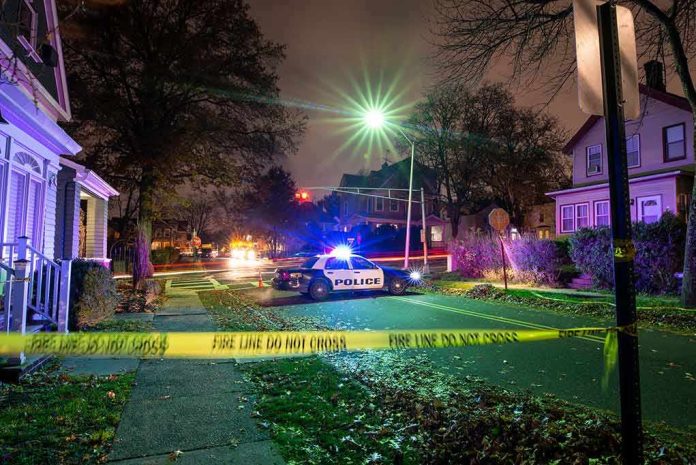
Nine people were shot at a backyard Halloween party in Bloomington, Illinois, leaving a 19-year-old college cheerleader dead — a stark reminder that most American mass shootings are not headline-grabbing rampages in public squares, but sudden bursts of gunfire in ordinary social spaces where young people gather.
At a Glance
- Nine people were shot around 1:30 a.m. in a shared backyard off East Division Street in Bloomington, Illinois; one victim, 19-year-old Giana (Gianna) Dettloff, died from multiple gunshot wounds.
- Police say victims ranged from 16 to 22 years old; an officer nearby reported hearing about 10 shots.
- No suspects were in custody days later; investigators are seeking witnesses and security footage.
- The incident meets common data thresholds for a mass shooting, though definitions vary across institutions.
What Happened: A Backyard Gathering Turns Deadly
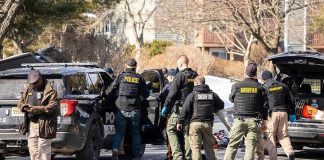
Shortly after 1:20 a.m., gunfire erupted in a common backyard behind rental properties in the 100 block of East Division Street in Bloomington, Illinois. Officers responding to reports — corroborated by a nearby Bloomington police officer who heard approximately 10 shots — found nine gunshot victims in and around the yard. One of them, 19-year-old Giana (also reported as Gianna) Dettloff of Carol Stream, a freshman cheerleader at North Central College, was mortally wounded. The McLean County coroner identified Dettloff and attributed her death to multiple gunshot wounds to the chest and pelvic region.
Authorities described the setting plainly: an off-campus Halloween party near Illinois Wesleyan University, with a shared backyard serving as the gathering point. Local reporting places the scene at or near 109 East Division Street, a cluster of rental units whose rear areas interconnect — a common layout in older Midwestern college-adjacent neighborhoods. The initial call reached police around 1:21 a.m., aligning with the officer’s account of hearing a rapid sequence of shots. Police leadership later confirmed the count: nine people shot, one dead, with survivors ranging in age from mid-teens to early twenties.
The Victims and the Early Investigation
Dettloff’s death anchored early coverage because the facts were concrete and sourced: a named coroner, identified wounds, and a timeline that matched police dispatches. The eight surviving victims were not publicly identified in the immediate aftermath; several were transported for treatment, and two remained hospitalized in stable condition days later, according to subsequent updates. As of that point, police said no suspect was in custody, and they had not determined whether a single shooter or multiple shooters were responsible.
Investigators appealed to the public — especially residents and partygoers — to share any video and firsthand accounts that could clarify the sequence of events. The request is standard in shootings with large crowds and fragmented perspectives; backyard parties create complex scenes, with overlapping sightlines, poor lighting, and sound reverberation off adjacent buildings. Police asked neighbors to check residential security systems and doorbell cameras; detectives also sought to identify a sizable attendee list to reconstruct movements before and after the gunfire.
Why This Qualifies as a Mass Shooting — And Why Definitions Still Matter
By the Gun Violence Archive’s commonly cited threshold — four or more people shot, excluding the shooter — the Bloomington party is unambiguous: nine gunshot victims in a single incident qualifies as a mass shooting. But the label is not universal across institutions. Scholarly and law enforcement frameworks sometimes reserve “mass shooting” for incidents with multiple fatalities, or distinguish among mass killings, mass public shootings, and active-shooter events; these choices significantly shift incident counts and shape public understanding.
The definitional debate is not pedantic. Policymakers, researchers, and the public draw conclusions from trend lines built on those definitions. An event like Bloomington — many injured, one killed, private or semi-private setting — will be included by some databases and not others. What does not change is the ground truth for families and communities: rapid, concentrated gunfire left one young woman dead and many others wounded at a social gathering. In that concrete sense, the incident’s gravity does not hinge on terminology.
Mechanics of an Investigation: What Evidence Can Resolve
Backyard shootings present particular evidentiary challenges — and opportunities. Ballistic analysis can determine how many firearms were used and whether recovered casings and projectiles match specific weapons. Trajectory mapping, when combined with photographs, casing locations, and medical wound paths, can place shooters and victims in three-dimensional space, even when human recollection splinters under stress. Body-worn camera timestamps, 911 recordings, and dispatch logs establish a hard timeline of first sounds, first calls, first officers on scene. When party sizes reach into the hundreds, as local coverage suggests here, synchronizing attendee smartphone videos and location data can knit together otherwise disjointed angles of a chaotic moment.
Investigators also scrutinize what preceded the shots: disputes, arrivals and departures, and whether unfamiliar individuals entered the yard. Those prelude details, if captured on doorbell cameras or phones, often prove decisive in identifying vehicles, clothing, or accomplices. In the early days of the Bloomington case, authorities signaled plainly what they needed: video, witnesses, and time to test claims against physical evidence.
What We Know — And What We Don’t Need to Speculate About
The established facts hold steady across independent local outlets and police-attributed statements. The setting was a Halloween party in a shared backyard near Illinois Wesleyan University; nine people were shot; a 19-year-old North Central College cheerleader died of multiple gunshot wounds; an officer reported hearing around 10 shots; and no suspect had been publicly identified in the days after. Those points rest on named officials, verifiable locations, and aligned timelines.
What remains appropriately outside the public record at this stage are motive, the number of shooters, and the identities and medical details of the surviving victims. Police called the shooting “isolated” and said there was no ongoing threat to the broader public — language that typically signals an absence of patterns suggesting serial or targeted community-wide danger — even as detectives continued to sort out responsibility. That single caveat reflects the investigation’s stage, not a dispute over the core facts.
Bloomington police said two victims of last weekend’s Halloween party shooting remain hospitalized in stable condition, while six others have been released. Giana Dettloff, 19, died at the scene. There is no suspect in custody. https://t.co/ahVHA9SJaa
— The Pantagraph (@Pantagraph) November 5, 2026
Community Consequence and the Pattern Behind the Particulars
The Bloomington shooting reads as painfully familiar to those who track firearm violence: a youthful social event, late hours, a compact outdoor space, and an eruption of gunfire measured in seconds. In incident databases that use numeric thresholds, such episodes populate far more rows than high-profile public massacres. They also generate complex trauma footprints — families grieving a promising young life ended, classmates processing survivor’s guilt, and neighborhoods living with the knowledge that the geography of daily life can be punctured by sudden violence.
The investigative work now — gathering video, stabilizing accounts, and matching ballistics — is painstaking but straightforward. It rarely accommodates instant narrative closure. What accountability demands, however, is often simple: identify who fired and how, charge appropriately, and explain the findings clearly to a community that showed up to celebrate and left altered. In Bloomington, the public call for footage and witnesses is a bet that those 150 to 200 attendees can help deliver that clarity.
Sources:
thegatewaypundit.com, wglt.org, wbtv.com, 25newsnow.com, people.com, chicagotribune.com, gunviolencearchive.org, congress.gov, hsdl.org, politifact.com, link.springer.com, pewresearch.org, fbi.gov, ojp.gov