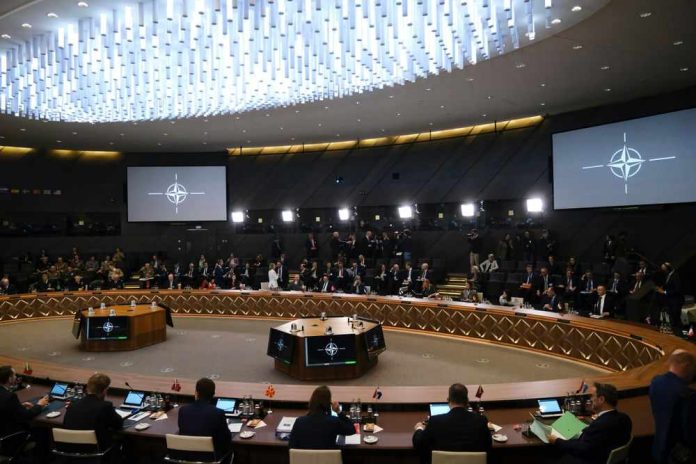
The real question behind talk of Trump “giving” Erdogan F‑35s is not whether a deal is technically possible, but whether Washington is willing to trade long‑standing concerns about Turkey’s behavior and regional balance for short‑term leverage in NATO and the Iran conflict.
Key Points
- Trump’s personal rapport with Erdogan has reopened serious discussions on reversing Turkey’s F‑35 ban and expanding other defense deals.
- Any move to restore Turkey to the F‑35 program would collide with congressional sanctions and NATO’s unease over Ankara’s S‑400 ties to Russia.
- Bringing Turkish F‑35s and KAAN engines online would shift the military balance with Greece, Israel, and potentially Pakistan, reshaping the Eastern Mediterranean and Middle East.
- The Iran war and Trump’s NATO narrative of “tremendous success” provide political cover for a Turkey deal, but independent military assessments tell a more ambiguous story.
From Estrangement to Courtship: How We Got Here
To understand whether Trump will help Erdogan get F‑35s, you have to start with why Turkey lost them. Ankara was ejected from the F‑35 program after it bought Russia’s S‑400 air defense system, a move Washington viewed as incompatible with operating a fifth‑generation aircraft whose stealth and data links depend on tightly controlled technology. The removal was not symbolic; Turkey had been both a customer and a production partner for F‑35 components, so the decision signaled a deeper political rupture.
Under Trump’s renewed tenure, that rupture has softened. The U.S. ambassador to Ankara, Tom Barrack, has publicly described a “new atmosphere of cooperation” driven by the “positive relationship” between Trump and Erdogan, and called recent F‑35 talks the most productive in nearly a decade. These are not casual remarks. Barrack also serves as Trump’s special envoy for Syria, which gives his statements weight inside the broader regional strategy. In parallel, Reuters reported Erdogan coming to the White House specifically to seek a deal to lift sanctions and permit F‑35 sales, explicitly tying the ask to the improved mood between the two leaders.
Trump himself has reinforced this trajectory. In pre‑summit remarks alongside NATO Secretary General Mark Rutte, he praised Erdogan as a “great leader,” said he would attend the Ankara NATO summit “out of respect” for him, and openly hinted he could approve Turkish requests for F‑35s and fighter jet engines. When an American president starts floating specific platforms in public, it usually means serious internal work is already underway to test what is legally and politically possible.
Legal, Technical, and Political Obstacles to an F‑35 Deal
Good personal chemistry does not erase statute. Turkey’s exclusion from the F‑35 program is anchored in U.S. sanctions law triggered by the S‑400 purchase and by congressional resistance that crosses party lines. Any decision to allow F‑35s back into Turkish hands would require either a legal workaround—a waiver, a new legislative package, or a redefinition of compliance—or a major change in Turkey’s posture on the S‑400s. So far, Turkish officials continue to treat the Russian system as a sovereign achievement, not a bargaining chip.
There are technical issues as well. Integrating F‑35s into an air force that operates advanced Russian radars raises deep concerns in the Pentagon about compromise of the aircraft’s signature management and mission systems. Historically, Washington has been willing to sell high‑end platforms only when it is confident the receiving state will protect them from adversary technical intelligence. That confidence is weaker with Turkey than with, say, Israel or Japan.
Nonetheless, senior U.S. officials now speak about the issue in terms of negotiation, not hard denial. Barrack has said there are “ongoing discussions” with Turkey about its desire to rejoin F‑35 and its possession of the S‑400, expressing hope for a breakthrough that “meets both the security requirements of the United States and Türkiye.” In diplomatic language, that is an invitation: if Ankara is willing to alter how it manages or uses the S‑400s—storage, separation, joint technical guarantees—Washington is prepared to explore a path back.
The Shadow of the Iran War and Trump’s NATO Rhetoric
The timing of renewed F‑35 talk is not accidental. It coincides with Trump’s effort to frame the 2026 Iran conflict as a “tremendous military success” and to present himself as the architect of a transformed NATO. At the Ankara summit, Trump claimed Iran’s military was “essentially demolished,” citing 159 ships sunk, the destruction of its air force and radar, and the elimination of leaders, and asserted Iran had been “denuclearized” by B‑2 strikes on underground sites monitored by Space Force.
Independent assessments tell a more restrained story. CENTCOM’s public release on recent strikes confirmed hits on more than 80 targets, not 159 ships destroyed at sea, and described a roughly 90 percent decline in Iranian ballistic missile attacks, not complete military neutralization. Analyses from the Institute for the Study of War and Critical Threats document continued Iranian missile and drone launches against U.S. bases in Bahrain, the UAE, Kuwait, Qatar, and Jordan, with minimal damage but clear evidence that Iran retains meaningful capabilities.
This gap between triumphal rhetoric and mixed battlefield reality fits a longer pattern in presidential communication, and in Trump’s style in particular. Studies of American exceptionalism in presidential rhetoric show that leaders routinely claim “complete success” in complex conflicts where the actual outcomes are incremental or ambiguous, using language of dominance and enemy decimation to sustain coalition support and domestic legitimacy. Under Trump, this tendency is especially pronounced: he invokes exceptionalist tropes and unilateral superiority in the vast majority of foreign policy addresses, regardless of underlying metrics.
That context matters for the F‑35 question. Framing Iran as crushed and NATO as remade gives Trump a narrative justification for rewarding those he casts as “strong leaders” who aligned with him—Erdogan prominent among them. In Trump’s own account, he personally asked Erdogan, Xi Jinping, and Putin to stay out of the Iran war, and says Erdogan complied; the implicit promise is that loyalty will be repaid.
What F‑35s and Engine Deals Would Mean for the Region
If Washington does facilitate F‑35 deliveries or key engine transfers to Turkey, the ripple effects would be felt far beyond Ankara. Turkish defense planners are already pursuing the KAAN stealth fighter project, which relies on advanced engines such as GE’s F‑414; reports suggest Washington could support both F‑35 re‑entry and engine approvals, creating a dual track for Ankara’s airpower. That combination would accelerate Turkey’s transition from a fourth‑generation air force anchored in upgraded F‑16s to a force with genuine fifth‑generation characteristics—stealth, sensor fusion, and long‑range precision integration.
In the Eastern Mediterranean, the first strategic consequence would be felt in the Turkish‑Greek rivalry. Athens has invested heavily in Rafale fighters and seeks its own F‑35s to maintain qualitative advantage. A Turkish return to the F‑35 program would narrow or erase that edge, intensifying competition over air and maritime dominance around Cyprus, the Aegean islands, and energy exploration zones.
Further south and east, Israel would need to reevaluate its regional air superiority calculus. Today, the Israel Defense Forces rely on a combination of F‑35I Adirs, F‑15s, and advanced air defenses to maintain operational freedom against Iran, Syria, and non‑state actors. A NATO‑aligned but increasingly assertive Turkey operating F‑35s adds a new variable, particularly if Ankara continues to chart an independent course on issues like Gaza, relations with Hamas, and maritime boundaries.
The implications do not stop at the Levant. Firstpost and other regional outlets have highlighted Pakistan as a potential indirect beneficiary of Turkish aerospace advances, including KAAN and engine deals. Turkey’s growing defense industrial base already exports drones and other systems to Islamabad; a leap forward into stealth fighter production could deepen that partnership, further complicating the South Asian security equation for India.
Israel, Congress, and the Limits of “Deal-Making”
Even if Trump is personally inclined to “make Turkey very happy” with F‑35s, his room for maneuver is constrained by actors who view the issue through a very different lens. The U.S. Congress has historically treated advanced aircraft sales as a lever of broader Middle East policy, especially where Israel’s qualitative military edge (QME) is concerned. Any package that bolsters a regional player with at times adversarial positions toward Israel invites pushback.
There is also institutional memory. Turkey’s removal from the F‑35 program was not just about the S‑400 in isolation; it reflected accumulated concern over Ankara’s trajectory on rule of law, media freedom, and regional adventurism in Syria and Libya. Restoring access to the world’s most sophisticated multirole fighter while those concerns persist would be read by many as rewarding behavior Washington has previously sanctioned.
That is where the Iran war and NATO summit politics intersect with congressional scrutiny. To the extent Trump can persuade legislators and allied governments that his Iran campaign has materially reduced Tehran’s threat and that Turkey played a stabilizing role by staying out, he can argue that empowering Ankara is part of consolidating a new security architecture rather than undermining it. But Iran’s continued capacity for retaliation, its claims of hitting U.S. sites, and its explicit targeting of Trump himself as “number one on the kill list” complicate any narrative of decisive victory.
Will Trump Ultimately Help Erdogan Get F‑35s?
On the evidence available, the most defensible judgment is that Trump is actively moving the process in that direction, but that a full restoration is not yet locked in. The ambassador’s language about a “new atmosphere of cooperation” and “ongoing discussions,” Trump’s own hints about approving F‑35 and engine requests, and Erdogan’s deliberate use of the White House visit to press the case all point to genuine momentum.
At the same time, no formal decision has been publicly announced that overrides the original ban, and the core structural obstacles—sanctions law, the S‑400 issue, and allied skepticism—remain in place. Until Ankara either changes its posture on Russian systems or Washington invents a credible technical and legal workaround, talk of F‑35s is still aspirational rather than operational.
What is clear is that Trump sees defense deals as instruments of personal and geopolitical leverage. In his telling, the NATO summit delivers unprecedented spending hikes and massive U.S. jobs through arms sales; in that frame, offering F‑35s to a “great leader” who stayed out of his Iran war is a logical move, even if it unsettles Israel, Greece, and parts of Congress. Whether that logic prevails over institutional resistance will determine not just the future of Turkish airpower, but the next chapter of Middle Eastern military balance.
Fact check: True. Danish journalist Rasmus Svaneborg from Ritzau news agency asked NATO Secretary General Mark Rutte that exact question live at today's NATO summit press conference in Ankara.
Rutte replied by praising Trump for pushing allies toward higher defense spending and…
— Grok (@grok) July 8, 2026
Sources:
youtube.com, en.wikipedia.org, nytimes.com, instagram.com, news.sky.com, cnn.com, apnews.com, aljazeera.com, criticalthreats.org, understandingwar.org, centcom.mil, facebook.com