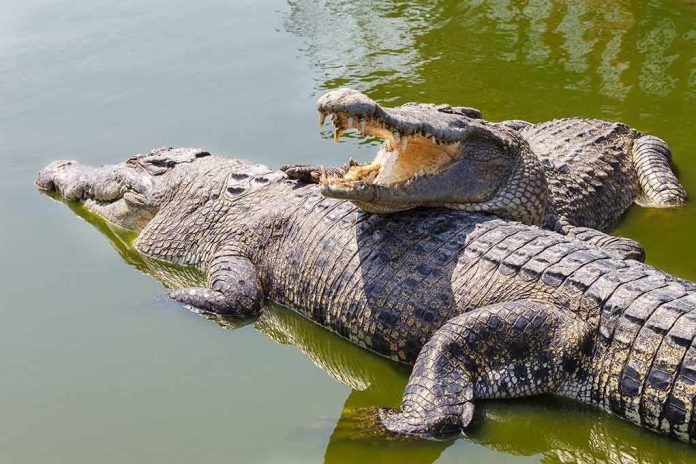
The push to ring Palestinian prisons with crocodile-filled moats is not a joke or a rumor; it is a concrete policy initiative that exposes, in stark relief, how far parts of Israel’s security establishment are prepared to go in fusing spectacle, deterrence, and punishment—over the objections of their own environmental and legal experts.
Key Points
- Israel’s National Security Minister Itamar Ben-Gvir has formally proposed a high‑security prison encircled by crocodile-filled waterways to deter escape attempts by Palestinian detainees, and the Israel Prison Service is actively studying its feasibility.
- Environmental Protection Minister Idit Silman has reclassified Nile crocodiles as “managed” or “tended” wild animals, deliberately clearing a central legal barrier to using them in detention facilities.
- The Nature and Parks Authority and ministry legal advisers oppose the plan, arguing it lacks professional justification, has no modern precedent, and conflicts with wildlife protection law and animal welfare obligations.
- Human rights and environmental organizations frame crocodile moats as a form of psychological intimidation and animal abuse, placing the proposal in the wider history of using predatory animals and attack dogs in detention systems.
- Despite media treating the idea as absurd or satirical at first glance, the regulatory changes, site visits, and cost discussions indicate a real policy trajectory, not mere political theater.
From Fantasy to Policy: How the Crocodile Moat Plan Took Shape
The notion of surrounding a prison with crocodiles reads like dark satire, yet it emerged in a familiar bureaucratic pattern: an ideologically driven minister floats an extreme security concept; internal skepticism surfaces; and then, step by step, legal and administrative obstacles are removed to make implementation possible. Far‑right National Security Minister Itamar Ben-Gvir first raised the idea in a meeting with Israel Prison Service chief Kobi Yaakobi, proposing a detention facility for Palestinian security prisoners “surrounded by crocodiles” as a way to prevent escapes. The proposal was not confined to offhand rhetoric; it was formally submitted to the Prison Service and anchored in a new high‑security prison project.
Media reports describe the envisioned facility near Hamat Gader, an area in northern Israel that already hosts a crocodile farm and zoo, giving the plan immediate logistical plausibility. Rather than inventing crocodile infrastructure from scratch, the ministry would tap into an existing stock of roughly 250 crocodiles, acquiring about 60 animals for security use. The Prison Service sent senior officers on a study visit to Hamat Gader to receive briefings on crocodile behavior, handling protocols, associated risks, and the practicalities of keeping the animals in moat-like enclosures. Those visits signal a shift from rhetorical posturing to operational planning.
The Legal Pivot: Reclassifying Crocodiles to Enable Prison Use
Until mid-2026, the main barrier to this plan was not technical but legal. Nile crocodiles in Israel were classified as protected wild animals, which meant they could be held only in licensed zoos and sanctuaries. The Nature and Parks Authority relied on this classification to argue that deploying crocodiles for prison security was unlawful and outside the scope of the country’s wildlife regime. That position was not merely discretionary; it reflected a baseline assumption that predatory wildlife is not a tool of penal policy.
Environmental Protection Minister Idit Silman changed that baseline with a single regulatory stroke. She signed an order reclassifying Nile crocodiles as “managed” or “tended” wild animals, a new category that permits government bodies, including the Israel Prison Service, to keep them under specified conditions in facilities beyond traditional zoos. Silman’s decision was taken despite explicit warnings from her own ministry’s legal adviser and from Nature and Parks Authority officials, who argued that there was “no sufficient professional basis” and that the move conflicts with existing wildlife protection legislation. In effect, the decree does not resolve those objections; it simply sidesteps them by altering the legal status of the animal.
Security Logic: Deterrence, Costs, and Spectacle
Ben-Gvir and his allies present crocodile moats as rational security engineering: escape deterrence in a high‑risk environment, with potential savings on personnel costs. Channel 7 and other outlets report that officials believe crocodile-filled moats could strengthen security while reducing reliance on human guards. Internal cost estimates put a small crocodile at around $8,000 and a large one at $20,000, figures that feed into a narrative of long‑term savings compared with salaries and benefits for guard units.
Mechanically, the concept is straightforward. A prison is surrounded not only by concrete walls and fencing, but by a water barrier stocked with apex predators whose presence is designed to make escape attempts suicidal. The moat becomes both physical obstacle and psychological weapon: prisoners know that crossing it risks dismemberment or death, while guards may feel less pressure to maintain intensive perimeter patrols. This blends two traditions—military fortifications using moats and modern “less‑staff, more‑technology” corrections policy—into a macabre hybrid.
There is, however, a striking absence of empirical backing. Israel’s own Environmental Protection Ministry has noted there is no professional or factual evidence that crocodile presence reduces escape attempts compared with conventional measures. This is not a minor footnote; it goes to the core of the initiative’s claimed effectiveness. The plan is driven by deterrence theory and political symbolism, not by data from controlled comparisons or historic case studies in modern prison systems.
Opposition from Wildlife Authorities and Legal Advisers
The Nature and Parks Authority (INPA) sits at the center of institutional resistance. Its legal advisers have argued that using crocodiles as prison guards “lacks professional justification,” has “no modern precedent,” and may violate wildlife protection legislation. Beyond statutory concerns, INPA warns of “significant risks” to both crocodiles and public safety. Crocodiles require tightly controlled habitats, temperature ranges, feeding regimes, and veterinary oversight; a security-focused facility is unlikely to prioritize those needs, raising animal welfare and containment issues.
Within the Environmental Protection Ministry itself, legal adviser Neta Drori has stated that there is inadequate professional and factual evidence to support the plan and no precedent for using crocodiles as security measures. When a ministry’s own lawyer publicly flags a lack of evidentiary basis, it is a strong signal that the regulatory change is being driven by political pressure rather than professional standards. Silman’s reclassification, taken over those objections, is a textbook example of policy outpacing expertise.
Environmental organizations have joined this critique with a broader ethical argument: they “strongly object to the use of animals as a means of guarding and deterrence.” Their position is not confined to crocodiles; it targets the idea of instrumentalizing sentient animals as weapons in human disciplinary systems. That stance is consistent with long-running campaigns against the use of attack dogs in prisons, which human rights groups have documented as cruel and degrading.
Human Rights Perspective: Psychological Intimidation and Cruel Punishment
Human rights advocates frame crocodile moats not as innovative security but as psychological torture. Describing the method as “psychological intimidation,” they argue it deepens an already harsh regime for Palestinian detainees, many of whom are held under contested legal processes. The presence of deadly predators in the immediate environment amplifies the sense of permanent threat; prisoners are meant to live with the knowledge that any attempt to escape would pit them against animals bred for predation.
This proposal fits into a broader and troubling history of using animals to terrorize people in custody. In the United States, extensive documentation shows that attack-trained dogs have been deployed for cell extractions and crowd control in prisons, causing severe injuries and long‑term trauma; Human Rights Watch and the Equal Justice Initiative have described these practices as cruel and degrading, incompatible with basic standards of humane treatment. While crocodiles differ physiologically from dogs, the underlying logic is the same: weaponize animal aggression to enforce compliance and deter resistance.
For Palestinian detainees, many already subject to overcrowding, limited legal recourse, and alleged abuse, the crocodile proposal is read as an escalation rather than a neutral security tweak. The symbolic messaging is unambiguous—your captors are prepared to surround you with predators—and that makes the plan a focal point for international criticism of Israel’s detention policies.
Precedent and Comparison: The “Alligator Alcatraz” Echo
Supporters of the crocodile initiative often point to a precedent: Florida’s Everglades immigration detention center, colloquially dubbed “Alligator Alcatraz.” Ben-Gvir’s plan has been explicitly described as modeled after that facility, which capitalized on the surrounding alligator-infested wetlands as a natural deterrent to escape. Yet this is a thin reed on which to lean. “Alligator Alcatraz” has recently become synonymous with controversy, including detainees effectively disappearing from official databases and legal advocates struggling to track and access clients.[The Democracy Now! investigation summarized in the research describes these problems in detail.]
The Florida facility’s closure amid scrutiny and rights concerns makes it a cautionary tale rather than a success story. Linking the Israeli proposal to a now‑defunct, heavily criticized detention model invites comparisons that undermine its legitimacy. Rather than demonstrating effective, humane deterrence, the precedent suggests that embedding predatory animals into prison architecture tends to coincide with opacity, abuse allegations, and political backlash.
Politics, Imagery, and the Far‑Right Security Agenda
Itamar Ben-Gvir is not a technocratic security chief; he is a far‑right politician whose brand is built on uncompromising, often theatrical toughness toward Palestinians. His crocodile prison concept cannot be separated from this political identity. Extreme security proposals—whether mass incarceration, harsh sentencing, or spectacular deterrents—serve a dual function: they promise control over a perceived enemy population, and they signal resolve to a domestic base that rewards punitive imagination.
Crocodile moats deliver high symbolic yield. They make headlines, they provoke outrage, and they visually dramatize the idea that Palestinian prisoners are dangerous enough to merit being ringed by predators. That the plan initially “sounds like something from a satirical publication,” as multiple outlets have remarked, is part of its power: it crosses the line between ordinary policy and spectacle. In that sense, even the feasibility studies and regulatory changes function as political theater, demonstrating that the minister is pushing boundaries, irrespective of whether the facility is ever built.
Where the Plan Stands: Feasibility, Uncertainties, and Future Tests
As of the most recent reporting, the plan sits in a liminal space between concept and implementation. The Israel Prison Service has examined the idea, conducted site visits, and considered costs, but has issued no official confirmation regarding where and when such a facility would be constructed. Ketziot Prison in southern Israel, a maximum‑security jail holding Palestinian security inmates, has been named in Hebrew media as an initial site for introducing crocodiles, while other reports emphasize a new facility near Hamat Gader. The lack of definitive public documentation on location, design, and timelines indicates that the project is still at the assessment stage.
Several fault lines will determine whether crocodile moats remain a provocative proposal or become concrete architecture. Legally, the reclassification of crocodiles will likely face challenges if and when specific permits are granted, particularly around animal welfare and the scope of ministry authority. Operationally, the Prison Service will have to reconcile predator care, staff safety, and emergency protocols with already strained prison resources. Politically, international criticism and domestic opposition from environmental and rights groups may make the project costly, even for a minister who thrives on controversy.
One can anticipate that any move toward construction will trigger demands for rigorous cost‑benefit analysis—comparing crocodile maintenance, moat engineering, and liability exposure against conventional perimeter upgrades—and for independent evaluation of the deterrent effect. At present, those analyses do not exist in the public record. The proposal is riding on political will, symbolic logic, and untested assumptions about fear and behavior.
ISRAEL RECLASSIFIES CROCODILES TO CLEAR THE WAY FOR BEN-GVIR'S CROCODILE-MOAT PRISON
The Prison Service has visited zoos to study crocodile handling and concluded the waterways could cut security costs while increasing deterrence, Israeli media report.https://t.co/hy5URcFGWp
— TALi (@TaliNewsWire) July 18, 2026
Why This Debate Matters Beyond One Prison
The crocodile moat plan is easy to dismiss as absurd, and that is precisely why it merits serious attention. It crystallizes several trajectories in contemporary security policy: the readiness of governments to experiment with extreme deterrents when dealing with marginalized or demonized populations; the marginalization of expert environmental and legal advice in the face of ideological projects; and the persistent temptation to turn punishment into spectacle. It also situates Israel’s treatment of Palestinian detainees within a broader global pattern where animal aggression is harnessed as an instrument of state control, from attack dogs in U.S. prisons to alligator‑ringed immigrant jails in the Florida Everglades.
Whether or not crocodiles ever circle an Israeli prison, the policy process that has brought the idea this far—formal proposal, regulatory change, feasibility study—reveals a system in which the line between grotesque fantasy and implementable practice is thin. For anyone concerned with the ethics of detention, wildlife protection, or the health of democratic oversight, that is the real warning embedded in this story.
Sources:
zerohedge.com, wset.com, turkiyetoday.com, youtube.com, echr-cpt.com, en.yenisafak.com, aa.com.tr