In meatpacking, immigration enforcement rarely stays “outside the gates.” Even when officers never step onto the kill floor, fear and labor uncertainty move faster than cattle; chain speeds fall, slaughter counts drop, and the effects propagate across feedlots, packers, and grocery coolers within hours.
At a Glance
- DHS publicly framed the southwest Kansas operation as targeting fugitives and criminal cases, not worksite raids at packing plants.
- Local officials reported no advance notice, and reporting consistently said agents did not enter the facilities themselves.
- Despite that, slaughter volumes fell sharply in the same window; industry groups attributed the slowdown to worker absenteeism and delayed cattle shipments.
- The pattern fits a long-standing dynamic in meatpacking: targeted enforcement can trigger broad, rapid operational ripple effects through fear and labor disruptions.
What actually happened and why the nuance matters
The Department of Homeland Security’s public position was categorical: this was not a worksite operation. Officials said Immigration and Customs Enforcement focused on individuals with criminal histories and outstanding removal orders, not on raiding plants or rounding up line workers wholesale. Multiple outlets echoed this framing, citing DHS statements that agents did not enter the beef facilities in southwest Kansas and operated instead in surrounding communities, where they pursued named targets and fugitives rather than the broader workforce. Kansas officials, for their part, said they were not given advance notice and could not verify arrest counts or identities in real time—a communications gap that left local institutions to interpret events as they unfolded on the street rather than inside the plants.
Against that official line sits a stark operational reality: as news and sightings of enforcement spread, many workers stayed home. Industry groups and community organizers reported that the prospect of arrest, whether at an apartment complex, a school drop-off, or a traffic stop, kept a meaningful share of the largely immigrant labor force from reporting to shifts; feedlots paused shipments they could not unload, and packers throttled back chain speeds accordingly. USDA daily slaughter tallies in that window showed an unusually sharp short-term downdraft, which livestock trade press pegged at roughly a 9% decline midweek followed by a drop near 16% the next day—magnitudes hard to reconcile with routine scheduling noise alone.
Mechanism: how enforcement outside the plant slows the line inside
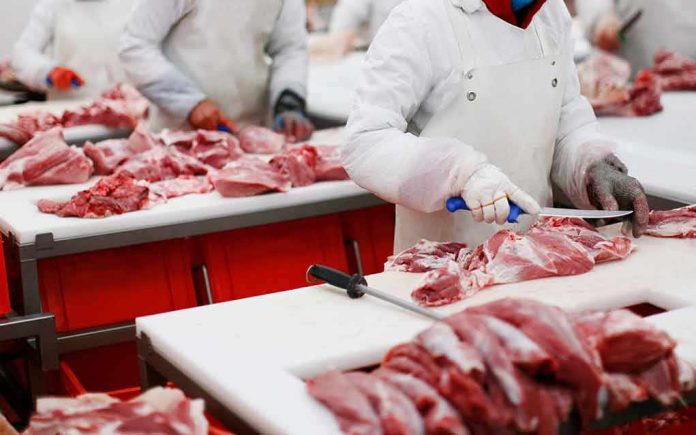
Beef packing is a tightly coupled system. A 3,000-head shift requires a full complement of knife hands, trimmers, utility and sanitation crews, maintenance techs, and USDA inspectors. Lose 10–15% of a shift to absenteeism—regardless of cause—and managers face three unappealing options: slow the chain, drop tasks and risk compliance failures, or cancel a shift outright. Because live cattle continue to gain weight and require feed, even a few hours of lost capacity “backs up” animals at feedyards and raises costs immediately. When the constraint is labor uncertainty triggered by immigration actions in the community, the shock transmits through attendance rather than arrests at the gate. That is why official denials of plant raids can coexist with real, measurable throughput losses.
The 2006 Swift raids established this pattern nationally; later academic and industry analyses have shown how immigration enforcement—whether broad or targeted—elevates turnover, depresses short-term productivity, and increases operational variance in food processing. One empirical study tied stepped-up deportations to increased food-safety inspection violations, pointing to destabilized staffing and training as plausible channels. In other words, the channel here is not exotic: fear raises absenteeism, absenteeism constrains staffing, constrained staffing lowers chain speeds, and lower chain speeds show up in that day’s slaughter count.
Competing narratives: narrow enforcement versus supply-chain harm
Two narratives surfaced. On one side, DHS emphasized intent and scope: targeted enforcement against criminals and removal absconders, no worksite entries, community operations conducted within legal authorities. That claim is specific and consistent across spokesperson statements; it deserves weight, and nothing in the public record shows agents sweeping kill floors in southwest Kansas during the window in question. On the other side, rancher groups, trade associations, and the meatpacking union pointed to outcomes: delayed shipments of “thousands of cattle,” “millions of dollars” in lost revenue, and a pronounced short-term slaughter decline they directly linked to the enforcement wave. Their statements reflect operational impact, not legal scope—and on impact, they were persuasive because the numbers moved when and where they said they did.
The apparent contradiction dissolves once you separate means from effects. You can conduct a narrowly targeted operation in the community and still trigger a broad labor response at plants that depend on immigrant workers—many lawfully employed, some not, all sensitive to risk. That is what happened here, and similar episodes have unfolded wherever labor markets are concentrated and communities hear sirens before they read statements.
How much did slaughter actually fall—and what else could explain it?
Daily slaughter data are noisy: maintenance outages, weather, and Monday holidays can distort week-over-week comparisons. Yet the midweek downdraft attributed to the Kansas enforcement period was large enough to prompt immediate coverage in ag media and futures commentary. DTN and other livestock outlets cited USDA’s daily reports showing a near-9% decline one day and roughly 16% the next; those are not routine hiccups, particularly when clustered in a region that anchors U.S. beef capacity. Could other factors have contributed? Possibly. Plants sometimes pull shifts for repairs; feedyards sometimes reshuffle loads. But the simultaneity of enforcement activity, local reports of delayed shifts, and labor absenteeism in the same corridor points to a dominant driver rather than coincidence.
It is also telling that cattle futures initially wobbled, reflecting traders’ attempts to discount short-term capacity loss, then stabilized as the market assessed duration. In beef, transitory shocks matter less than persistent ones; a two-day slowdown can be made up with Saturday kills, but a prolonged labor chill bleeds into boxed-beef availability and, ultimately, retail prices. Industry statements warning of higher prices were therefore not idle speculation so much as a signal about duration risk if enforcement and fear persisted.
1/ Today's @FarmPolicy News Summary covers how "increased actions by US #immigration enforcement are creating significant disruption to #beefpacking operations in #Kansas, an area where nearly all of the country’s major processors have operations."https://t.co/WjNcI8MHqg
— FarmPolicy (@FarmPolicy) September 28, 2026
What this means for policy and operations going forward
Three lessons repeat across episodes like this. First, communications discipline matters. When local officials are surprised and communities learn details piecemeal, rumor fills the gap and absenteeism spikes. Second, even targeted actions carry systemwide costs in labor-dense industries; policymakers should budget for those costs if they choose this tool and weigh whether objectives—removing named fugitives—could be met with less collateral disruption through timing, coordination, or alternative approaches. Third, plants and feedyards need contingency playbooks that assume sudden labor shocks: cross-trained crews, overtime capacity, and rapid schedule recovery to avoid animal welfare pinch points when cattle back up at yards.
The Kansas “golden triangle” functions as a national choke point for beef. That is why localized enforcement, even outside the gates, can look like a national supply story within a day. The legal question—who was targeted and on what warrants—belongs to DHS and the courts. The operational question—how a community operation knocked down slaughter counts—has a simpler answer rooted in workforce behavior and system design. When a labor-dependent industry concentrates capacity, proximity enforcement becomes de facto supply-chain policy. The surprise is not that slaughter plunged during the crackdown window; it is that we still call that outcome unintended.
Sources:
zerohedge.com, reuters.com, nytimes.com, yahoo.com, farmpolicynews.illinois.edu, dtnpf.com, cattlereport.agcenter.com, kcur.org