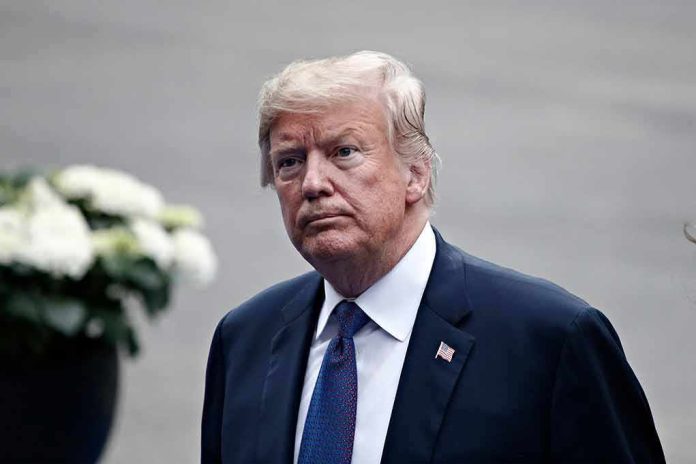
The important fact is not that Trump stumbled into a bizarre phrase; it is that he turned a real, ongoing legal fight over college sports and transgender-athlete policy into a sweeping slogan that is plainly wider than any actual court holding. In the record available here, no court is shown to have declared “sports” unconstitutional as such; the dispute is about how specific sports rules were judged, and Trump’s rhetoric deliberately collapses that distinction.
Intro Header
- Trump really did say that a judge “declared sports unconstitutional,” and he repeated the same basic complaint in related remarks.
- The most specific court reference in the coverage points to NCAA antitrust litigation, not a ruling that sports themselves are unconstitutional.
- The broader legal battlefield includes college-athlete compensation, NIL, transgender participation, and federal-state fights over Title IX enforcement.
- The phrase works as political shorthand, but it is not a clean description of any identified judicial holding.
Why the phrase is misleading
Trump’s line has the structure of a sound bite, not a legal description. In the contemporaneous White House coverage, he said, “We had a bad judge’s decision, and, uh, a judge that knew nothing about sports declared sports unconstitutional. Can you believe it?” In a separate roundtable, the same theme reappeared in slightly different form: a judge who knew nothing about sports, football, or the Olympics had “decided everything was unconstitutional.” That is the key to understanding the remark. Trump was not making a careful claim about constitutional doctrine; he was compressing a judge’s sports-related ruling into a maximalist accusation.
The evidence in the package supports that interpretation. Fox News says Trump was “likely referring” to Judge Claudia Wilken and to a 2019 NCAA case involving education-related benefits, which is an antitrust dispute, not a holding that the institution of sports is unconstitutional. That distinction matters. Antitrust law asks whether a market restraint is unlawful; constitutional law asks whether government action violates the Constitution. Those are different legal regimes, with different remedies, different reasoning, and different implications. Trump’s wording smears them together for rhetorical force.
The likely legal referent: college sports, not sports itself
The strongest clue to what Trump was actually talking about is the cluster of college-athletics disputes surrounding NIL, compensation, and NCAA governance. Fox News links his complaint to Judge Wilken’s ruling on NCAA limits, while other coverage in the package places his comments in the context of the ongoing college-sports overhaul. Reuters-style summaries quoted in the research package describe Wilken’s earlier ruling in O’Bannon v. NCAA as an antitrust decision that found the NCAA had unlawfully blocked certain athlete compensation arrangements. That is the kind of judicial action that can “blow up” a familiar system without ever approaching a declaration that sports are unconstitutional.
The same pattern appears in Trump’s other remarks on the topic. In another clip, he complained that a judge was “allowed” to “destroy college sports and colleges,” again framing the dispute as judicial overreach into the college-sports economy rather than constitutional invalidation of athletics itself. Even his criticism of the NCAA NIL system follows this logic: he called the current arrangement a “mess,” blamed a 2021 Supreme Court ruling on the NCAA case, and said he did not think it was right for a judge to have that kind of effect on college sports. The through line is not doctrinal precision; it is grievance at the scale of judicial impact.
Where the real disagreement sits
The honest dispute is not over whether some judge literally outlawed sports; it is over what courts may do to long-standing sports institutions when those institutions run into antitrust, civil-rights, or statutory constraints. The Minnesota Attorney General’s office, for example, issued a formal opinion saying Trump’s “Sports Ban Order” lacked the force of law and did not override state protections for transgender students. That filing presents a direct legal rebuttal to Trump’s broader effort to cast federal sports policy as decisive and self-executing. It also shows how quickly sports politics moved beyond college compensation into a separate fight over sex, identity, and access to girls’ and women’s teams.
On the transgender-athlete front, the package also shows that the Supreme Court upheld state laws banning transgender athletes in girls’ sports, while coverage emphasized that the decision did not magically resolve every downstream question in the broader legal landscape. That matters because Trump’s sports rhetoric often folds distinct controversies into one narrative: NCAA compensation, transgender participation, Title IX enforcement, and executive orders become interchangeable pieces of a single story about judges meddling in “sports.” They are not interchangeable in law. A Title IX dispute is not an antitrust dispute, and a state-law battle over transgender participation is not a declaration that athletics itself is unconstitutional.
Why the wording travels so well
Trump’s phrasing is effective because it attaches a sweeping moral charge to an abstract legal issue. “A judge declared sports unconstitutional” sounds absurd, memorable, and hostile in a single breath. It also gives listeners a simplified villain: an out-of-touch jurist who supposedly overrode common sense. The problem is that the simplification erases the actual substance of the disputes, which are narrower, technical, and much easier to misunderstand if they are only heard through political shorthand. That is why the phrase survives even though the record points instead to antitrust rulings, NCAA compensation fights, and transgender-athlete litigation.
There is another reason the line resonates. Sports law is now a dense intersection of money, identity, labor, and institutional control. College athletics has moved far beyond the old amateurism model; NIL compensation, transfer rules, conference realignment, and litigation over athlete rights have made the entire field legally unstable. At the same time, the transgender-athlete fight has become one of the most politically charged fronts in education law, with state statutes, executive orders, and constitutional arguments all colliding. In that environment, a flamboyant claim can feel plausible even when it is imprecise. Plausibility is not the same thing as accuracy.
What a careful reading supports
The best-supported reading is straightforward. Trump did make the statement that a judge had declared sports unconstitutional, and he used that line as part of a broader attack on judicial decisions affecting college athletics and related sports policy. The available record does not identify any opinion holding that sports, as such, are unconstitutional. Instead, it points to specific rulings on NCAA compensation, NIL, transgender participation, and executive-branch efforts to reshape sports rules. In other words, the quote is real; the legal description inside it is not.
Sources:
mediaite.com, rawstory.com, foxnews.com, marathonhandbook.com, ag.state.mn.us, bloomberg.com, en.wikipedia.org, supreme.justia.com, theindianalawyer.com
Trump Claims, ‘A Bad Judge Declared Sports Unconstitutional’ https://t.co/UIPSwrgBnZ
— Mediaite (@Mediaite) August 7, 2026