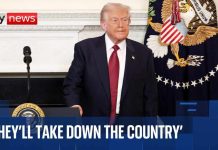
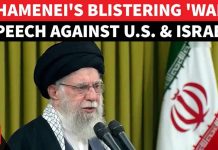
Iran’s threat of a “most devastating offensive” has put American troops and allies in the crosshairs—and President Trump is warning Tehran the next move could trigger a U.S. response “with a force that has never been seen before.”
Story Snapshot
- President Trump issued a public warning on Truth Social after Iran signaled it would escalate attacks.
- U.S. and Israeli strikes on Iran, described as “Operation Epic Fury,” began February 28 and are expected to last days.
- Reports of Iran’s Supreme Leader Ayatollah Ali Khamenei’s death added uncertainty and heightened the risk of IRGC retaliation.
- Iran’s actions reportedly included missile strikes on Israel and an attack on a U.S. Navy support vessel as of March 1.
Trump’s Deterrence Message as Iran Signals Escalation
President Donald Trump warned Iran against intensifying attacks after Tehran signaled retaliation following U.S.-Israel strikes. Trump posted that Iran said it would “hit very hard” and cautioned that if it did, the United States would respond “with a force that has never been seen before.” The message landed as fighting continued into March 1, with regional targets—including Israel and U.S. assets—under renewed pressure.
Iran’s Revolutionary Guard threats have focused on U.S. bases, Israel, and Gulf partners, according to reporting that cited Iranian state-linked outlets. The posture reflects a classic escalation ladder: Tehran signals broader targeting to deter follow-on strikes, while Washington signals overwhelming capacity to prevent attacks on Americans. For voters tired of drift and mixed signals in foreign policy, the immediate question is whether deterrence holds—or whether U.S. forces are pulled into a wider regional fight.
Operation Epic Fury and the Fast-Moving February 28–March 1 Timeline
U.S. and Israeli forces struck Iran on February 28, hitting major cities and military sites as part of operations framed as degrading missile infrastructure and preventing nuclear-related threats. Iran responded with missile strikes on Israel the same day, and hostilities continued into March 1. U.S. officials described the campaign as “major combat operations” expected to last days, a timeline that raises the stakes for force protection across the region.
As of March 1, Iran also reportedly struck a U.S. Navy support vessel, sharpening the risk of direct U.S.-Iran confrontation. The operational reality is straightforward: ships, bases, and airfields in the Gulf create both strategic reach and vulnerable targets. Any credible deterrence posture has to account for Iran’s ability to strike through missiles, drones, and proxy-aligned networks, even as U.S. power remains dominant when fully engaged.
Khamenei’s Reported Death Adds Uncertainty to IRGC Decision-Making
Reports emerging February 28 indicated Supreme Leader Ayatollah Ali Khamenei may have been killed in an Israeli strike, a development that—if confirmed—would represent a seismic shock inside the Iranian regime. Multiple outlets reported the situation while acknowledging that timing and confirmation details varied. Leadership disruption can cut two ways: it can slow decisions while factions compete, or it can accelerate retaliation if hardliners move to prove control and restore deterrence.
The IRGC’s posture matters because it functions as both a military arm and an internal power center. Public threats of a historic or unprecedented offensive, especially after leadership turmoil, are often designed to project unity and strength. For Americans focused on security and stability, the main measurable test will be whether Iran chooses symbolic actions it can manage—or attempts higher-casualty strikes that force Washington and Jerusalem into broader and longer operations.
War Powers Pushback Revives a Constitutional Fight at Home
Congressional debate intensified as operations expanded, with lawmakers demanding briefings and some calling for formal authorization. Reporting described a split that cuts across party lines: several Democrats argued the operation is unlawful without congressional approval, while GOP leaders and some senators backed the strikes as necessary to protect U.S. interests. The dispute is not academic—how Washington defines war powers directly impacts how long operations continue and under what legal rationale.
[UPDATED] Trump: U.S. Will Hit 'With a Force Never Seen Before’ if Iran Escalates – PJ Media
— GuitarMan (@palumb61466) March 1, 2026
Conservatives generally favor a strong national defense while also insisting the Constitution’s separation of powers be respected. The immediate challenge for the administration is to keep Americans safe without sliding into an open-ended conflict with unclear objectives. With energy markets sensitive to Gulf instability and U.S. forces exposed across the region, the next days will test whether deterrence, military pressure, and constitutional process can align under rapid-fire events.
Sources:
Trump threatens “force never seen before” after Iran signals retaliation
https://www.jpost.com/middle-east/iran-news/article-888299
https://www.aol.com/articles/donald-trump-promises-hit-iran-064331984.html
https://foxnews.com/live-news/israel-us-launch-attack-on-iran-amid-escalating-protests